



AUGUSTA — With time running out for the Legislature’s reapportionment commission to reach a consensus plan to redraw the boundaries for Maine’s congressional districts, Republicans and Democrats on Tuesday took a step closer toward partisan entrenchment.
Just moments before a public hearing that drew testimony from more than 45 residents, the commission’s GOP representatives withdrew an alternative redistricting plan that they said addressed Democrats’ biggest concerns in a Republican proposal unveiled last week.
The GOP decision illustrated the lingering distrust between both parties and set the redistricting process on a path that could end in federal court.
Each party blamed the other for the stalemate.
Republicans accused Democrats of stalling on agreeing to the GOP alternative map so they could use Tuesday’s public hearing to bloody the GOP over an initial proposal that’s been blasted by critics for gerrymandering and moving 360,000 residents and 139 municipalities into a new congressional district.
Democrats countered that they first wanted the GOP to release its alternative plan to the public on Tuesday before solidifying an agreement. Democrats added that they had no assurances that the GOP’s alternative plan wasn’t a smokescreen, much less a plan that’s supported by the majority of the Republican caucus.
That plan has not been presented to the public despite an agreement from both sides last week that alternative proposals would be disclosed Friday and unveiled during Tuesday’s public hearing.
Democrats released their new plan Friday and discussed it during Tuesday’s public hearing.
The Republican alternative plan was shown to Sen. Seth Goodall, D-Richmond, Friday. Goodall said Democrats were receptive to the proposal, but they couldn’t be sure if it was a genuine proposal.
“We don’t always know who we’re negotiating with,” Goodall said. “We’re questioning . . . how committed the Republicans are to this plan.”
Two Republicans on the commission acknowledged that some members were uncomfortable with the compromise. Sen. Debra Plowman, R-Hampden, said GOP support for the alternative deteriorated over the weekend as Democrats continued their rhetoric over the first Republican proposal.
Plowman said some in her caucus thought that the alternative plan gave up too much, including keeping Androscoggin County in the 2nd Congressional District. Plowman said Democrats were seeking “total capitulation.”
Plowman added that Democrats should make concessions, not Republicans, who are in the majority.
“We shouldn’t have to give up everything,” she said.
At the moment, it appears the GOP is unwilling to surrender its plan to move Androscoggin County into the 1st Congressional District. Democrats have derisively called the plan “Raye-districting” because it presumably increases the chances that Senate President Kevin Raye, R-Perry, can defeat incumbent U.S. Rep. Mike Michaud, D-Maine, in 2012.
Raye, who has expressed interest in a congressional run, lost to Michaud in 2002 by about 9,000 votes. More than half of that margin was in Androscoggin County.
The GOP plan also moved North Haven out of the 1st District. North Haven is the home of U.S. Rep. Chellie Pingree, D-Maine.
Plowman said Tuesday that the GOP was willing to leave North Haven in the first district, but that Androscoggin County was off the table.
“We will not be offering a consensus plan,” Plowman said. “… Lewiston-Auburn will go to the 1st Congressional District.”
Dan Billings, a Republican member of the commission and Gov. Paul LePage’s chief legal counsel, said he had hoped the Democrats would have agreed to the GOP’s alternate plan after the weekend. Asked why the GOP didn’t release the alternative plan Friday, as Democrats did, Billings said they withheld doing so at the Democrats’ request.
Billings said he expected to get an answer from Democrats before the public hearing. He also indicated that the GOP was willing to take the heat for advancing a more partisan plan, even if it meant circumventing the two-thirds majority requirement for Legislative redistricting approval enacted in 1975.
Doing so could prompt Democrats to challenge the constitutionality of the new redistricting plan in federal court.
Billings was confident that Republicans could withstand the legal challenge.
“The compromise plan is something we’d be willing to do if it was a compromise, if the Democrats were on board,” Billing said. “If we’re going to get beat up for pushing something through, we’re going to pass a map that we think is better.”
He added, “They (Democrats) seem to have difficulty understanding that they’re not in control. And at the end of the day you need to compromise.”
Democrats initially introduced a proposal that would move the town of Vassalboro, 4,300 people, to the 2nd Congressional District, creating a population deviation of 11 people. Democrats on Friday offered a compromise that brought the population deviation between the two districts down to three people.
The current GOP proposal brings the population deviation to one person.
The new Democratic plan moves 19,191 people in seven towns. It puts Unity Township, China,Vassalboro, Rome, and Albion in the 2nd Congressional District, while moving Oakland and Wayne in to the 1st Congressional District.
Similarly, Billings said the unpublicized Republican alternative would affect only towns in Kennebec County.
But that proposal appears to be off the table. Goodall was hopeful that the public hearing, which was decidedly against the GOP’s initial map, would convince Republicans to reconsider the alternative plan.
“We feel that their (alternative) plan isn’t that far off,” Goodall said. “If we can negotiate in good faith, we can get this deal done.”
The 15-member bipartisan commission must find a way to balance the populations of the two congressional districts, which fell out of balance between the 2000 census and the one recorded in 2010, when the 1st District swelled to 668,515, compared to the 2nd, which only expanded to 659,846, a difference of 8,669 residents.
The redistricting effort is aimed at equalizing the populations of both districts. A federal court case stresses the need to have new districts in place before the general elections in November 2012.
Several previous redistricting efforts, including the most recent one in 2003, have also been settled in court after the two parties couldn’t reach an agreement.
Meanwhile, Republicans and Democrats dismissed a lawsuit filed last week by Mike Turcotte, an unenrolled voter from Bangor, who alleges that the two dominant political parties hold too much sway over the redistricting process.
Turcotte said the composition of the commission, which includes just one unenrolled member, denies his right to “equal representation” under the U.S. Constitution.
smistler@sunjournal.com
-

- Michael Friedman, of Bangor, chairman of the Reapportionment Committee comments while Mainers testify before the Commission at the State House in Augusta, Maine on Tuesday, Aug. 23, 2011. Testimony was heard on competing congressional redistricting proposals from the public. A special legislative session is scheduled to take up the issue on Sept. 27. (AP Photo/Pat Wellenbach)

-
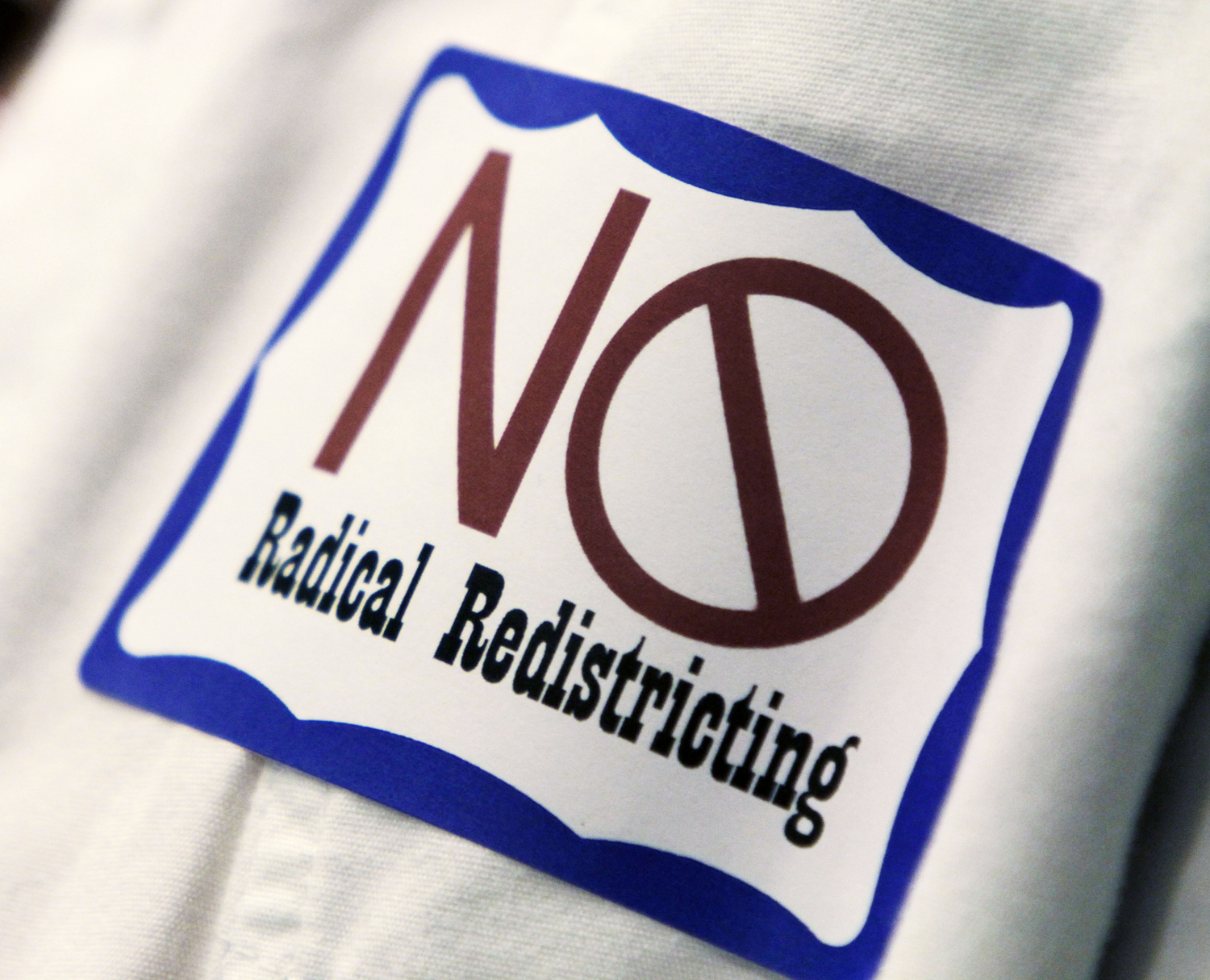
- A sticker is seen by one of the Mainers who testified before the Reapportionment Commission at the State House in Augusta, Maine on Tuesday, Aug. 23, 2011. Testimony was heard on competing congressional redistricting proposals from the public. A special legislative session is scheduled to take up the issue on Sept. 27.(AP Photo/Pat Wellenbach)
Send questions/comments to the editors.
