



1:06 a.m. — President Donald Trump has won Texas and its 38 electoral votes despite a furious, late push by Democrats to turn America’s biggest red state blue.
An avalanche of early votes fed Democrats’ high hopes of ending decades of losses in Texas, where polls showed Joe Biden running unusually close. But Trump carried Texas for a second straight year.
Trump won Texas by 9 percentage points in 2016 and all but took a win here for granted. He didn’t swing through Texas for campaign rallies or swamp television airwaves, and his conservative allies on the ground scoffed at Biden’s chances as a far reach.
Trump sought to make an issue out of Biden’s answer during their final presidential debate that Biden would “transition away from the oil industry” if elected president. Texas is among the swing states with voters who depend on the oil industry to make a living.

Donald Trump wins Florida
Updated 12:35 p.m. — President Donald Trump has won Florida and its 29 electoral votes, the biggest prize among the perennial battlegrounds and a state crucial to his reelection hopes.
A victory in Florida means reelection is within Trump’s grasp. A loss in the state would have made it nearly impossible for Trump to reach the 270 electoral votes needed to retain the White House.
Democrat Joe Biden’s campaign had hoped the devastating toll of the coronavirus pandemic, particularly among older adults, would put him in a strong position in a state popular with retirees.
Trump moved his official residence to his Palm Beach estate Mar-a-Lago from New York last year.
Trump narrowly beat Democrat Hillary Clinton in the state in 2016.
Joe Biden wins Minnesota
Updated 12:13 p.m. — Democrat Joe Biden has carried Minnesota, turning back a strong push by President Donald Trump and holding on to a state narrowly won by Democrat Hillary Clinton four years ago.
Biden was awarded the state’s 10 electoral votes on Tuesday.
Biden made up for his campaign getting a late start in Minnesota compared with Trump, who held several campaign rallies in the state this election cycle. The former vice president took advantage of anti-Trump sentiment and organizing efforts by the state’s Democrats, who stressed COVID-19 and health care issues.
Trump came within 1.5 percentage points of carrying Minnesota in 2016 and made winning the state this time a personal priority. Republicans invested time and money in building a field organization to boost GOP turnout, focusing on conservative rural Minnesota and suburban areas that were once mostly Republican but have become swing territory.
The last Republican presidential candidate to capture the state was Richard Nixon in 1972.
Joe Biden wins Hawaii
Updated 12:06 a.m. — Democrat Joe Biden has won the state of Hawaii.
He was awarded its four electoral votes on Tuesday.
Hawaii is a reliably Democratic state and last went for a Republican presidential candidate in 1984, when it was won by Ronald Reagan.
Donald Trump wins Utah
Updated 11:08 p.m. — President Donald Trump has won the state of Utah.
The Republican nominee on Tuesday was awarded its six electoral votes.
Utah hasn’t supported a Democratic presidential candidate since Lyndon B. Johnson in 1964.
Trump won Utah in 2016, but independent candidate Evan McMullin had a strong showing in the state owing to widespread distaste of both Trump and Democrat Hillary Clinton. McMullin captured more than 20% of the vote.
Biden wins 3 Western states, Trump takes Idaho
Updated 11 p.m. — Democrat Joe Biden has won California, Oregon and Washington state, while President Donald Trump has won Idaho.
California, Oregon and Washington are all liberal states, while Idaho is conservative.
California has 55 electoral votes, the biggest haul of any state. It’s also the home of Biden’s running mate, Sen. Kamala Harris. She served as the San Francisco district attorney and the state’s attorney general before winning election to the Senate in 2016.
Biden nets 74 electoral votes for the three Western states, while Trump takes four electoral votes from Idaho.
Joe Biden wins Missouri
Updated 10:54 p.m. — Democrat Joe Biden has won New Hampshire and its four electoral votes, holding on to a state that President Donald Trump only narrowly lost in 2016.
The state was considered a 2020 battleground despite not going for a Republican presidential candidate since George W. Bush in 2000.
Four years ago, Democrat Hillary Clinton won the small state over Trump by roughly 2,700 votes. That’s less than 1% of the 732,000 ballots cast, and it was the second-closest margin of victory in the country.
Biden didn’t fare as well in New Hampshire’s first-in-the-nation Democratic primary in February. He finished a dismal fifth, behind Bernie Sanders, Pete Buttigieg, Amy Klobuchar and Elizabeth Warren. But his candidacy took off after a commanding win later that month in the South Carolina primary, leading to the exits of several of his competitors.
Donald Trump wins Missouri
Updated 10:31 p.m. — President Donald Trump has won the state of Missouri.
The Republican nominee on Tuesday was awarded its 10 electoral votes.
In 2016, Trump beat Democrat Hillary Clinton in the state by 18 percentage points.
Donald Trump wins Kansas
Updated 9:59 p.m. — President Donald Trump has won the state of Kansas.
The Republican nominee on Tuesday was awarded its six electoral votes.
In 2016, Trump coasted to victory over Democrat Hillary Clinton by 20 percentage points in the state.
Joe Biden wins Colorado
Updated 9:37 p.m. — Democrat Joe Biden has won the state of Colorado.
He was awarded its nine electoral votes on Tuesday.
The state, which went for Democrat Hillary Clinton four years ago, has trended sharply to the left since President Donald Trump’s 2016 election.
The state also has a competitive Senate race between Republican incumbent Cory Gardner and the state’s former governor John Hickenlooper. Gardner is considered one of the nation’s most vulnerable senators.
Joe Biden wins District of Columbia
Updated 9:27 p.m. — Democrat Joe Biden has won the District of Columbia.
He was awarded its three electoral votes on Tuesday.
District voters have been allowed to cast presidential ballots since 1964 and have always voted overwhelmingly Democratic. Hillary Clinton’s win in the District over Republican Donald Trump in 2016 was the widest margin ever.
Trump wins 5 more states, Biden adds 2 states
Updated 9 p.m. — President Donald Trump has won Louisiana, Nebraska, Nebraska’s 3rd Congressional District, North Dakota, South Dakota and Wyoming, while Democrat Joe Biden has won New Mexico and New York.
Nebraska, one of two states that divides its electoral votes, has five total electoral votes up for grabs. Trump won the statewide vote, which is good for two electoral votes. He also won the 3rd Congressional District, which nets him a third vote.
Nebraska’s 1st and 2nd congressional districts haven’t yet been called.
Trump nets 20 electoral votes from his wins in Louisiana, Nebraska, Nebraska’s 3rd, North Dakota, South Dakota and Wyoming, while Biden takes 34 electoral votes for winning New Mexico and New York.
Donald Trump wins Indiana
Updated 8:52 p.m. — President Donald Trump has won the state of Indiana.
The Republican nominee on Tuesday was awarded its 11 electoral votes.
Indiana is the home state of Trump’s running mate, Vice President Mike Pence.
Trump won Indiana by 19 percentage points in 2016 over Democrat Hillary Clinton.
Donald Trump wins Arkansas
Updated 8:30 p.m. — President Donald Trump has won the state of Arkansas.
The Republican nominee on Tuesday was awarded its six electoral votes.
Arkansas is a reliably Republican state that hasn’t gone for a Democratic presidential candidate since Bill Clinton in 1996.
Trump wins 4 states, while Biden takes 7 states
Updated 8 p.m. — President Donald Trump has won Alabama, Mississippi, Oklahoma and Tennessee, while Democrat Joe Biden has won Connecticut, Delaware, Illinois, Maryland, Massachusetts, New Jersey and Rhode Island.
The results were not a surprise. Biden is very strong in the states that went for him, just as Trump is strong in the states he won.
Trump takes 33 electoral votes for winning those four states, while Biden adds 69 electoral votes to his total for winning seven states.
Trump wins South Carolina
Updated 7:56 p.m. — President Donald Trump has won the state of South Carolina.
The Republican nominee on Tuesday was awarded its nine electoral votes.
Trump handily won the state in 2016 over Democrat Hillary Clinton. South Carolina hasn’t voted for a Democratic presidential candidate since Jimmy Carter in 1976.
Joe Biden’s victory in the South Carolina primary in February started a wave of wins that helped cement his status as Democrats’ presidential nominee. South Carolina Republicans didn’t hold a primary, an early sign of their support for Trump’s reelection.
Joe Biden wins Virginia
Updated 7:36 p.m. — Democrat Joe Biden has won the state of Virginia.
He was awarded its 13 electoral votes on Tuesday.
Democrat Hillary Clinton won Virginia over Republican Donald Trump in 2016, helped in part by her choice of running mate: Virginia Sen. Tim Kaine.
Virginia has grown increasingly liberal over the last four years, and as a result of the 2019 elections, Democrats now control every branch of government in the state.
Donald Trump wins West Virginia
Updated 7:30 p.m. — President Donald Trump has coasted to victory in West Virginia, taking its five electoral votes.
The Republican nominee defeated Democrat Joe Biden on Tuesday in a reliably conservative state.
The last Democrat to win a presidential race in West Virginia was Bill Clinton in 1996.
Trump defeated Democrat Hillary Clinton in West Virginia four years ago by 42 percentage points, one of his highest margins of victory in the nation. Many in the state credit him for his conservative populism and promises to help the declining coal industry, even as few expected he could bring back jobs in a dying field.
Trump wins Kentucky; Biden carries Vermont
Updated 7 p.m. — President Donald Trump has won Kentucky, and Democrat Joe Biden has carried Vermont.
They are the first two states called in the 2020 presidential election.
Kentucky is reliably conservative, while Vermont is considered one of the most liberal states.
Trump wins eight electoral votes from Kentucky, while Biden takes three for winning Vermont.
High stakes at all levels fuel the turnout in newly competitive Texas
AUSTIN, Texas — Texas was unusually shaky ground for Republicans on Tuesday as a record surge of voters in America’s biggest red state, typically among the worst for turnout in the U.S., lined up to decide the most unpredictable election here in decades.
The high stakes in Texas rippled beyond whether President Trump was genuinely at risk of becoming the first Republican presidential nominee since 1976 to lose the Lone Star State. Democrats, shut out of power in the Texas Capitol for a generation, were also within reach of seizing the majority in the state House chamber for the first time in nearly 20 years — an outcome that would mark a new era in what has been America’s foremost factory of conservative legislation.
Republican Sen. John Cornyn was also taking seriously a challenge from Democrat MJ Hegar in what was coming down to a second surprisingly close U.S. Senate race in Texas in as many years. Even progressive congressional challengers who back the Green New Deal were presenting serious challenges to longtime Republican incumbents in districts that run through some of Texas’ most conservative counties.
Turnout in Texas was massive, and already at record levels.
In Houston, Corbin Clark, 29, a forklift driver, said Tuesday was the first time he had ever voted. Clark voted at a community center in Acres Homes, a historically Black neighborhood in northwest Houston.
Clark said he didn’t know why he hadn’t previously voted, but he cast his ballot for president for Democrat Joe Biden.
“My momma got on my case,” Clark said, laughing. “She told me I needed to go vote and use my voice.”
In Dallas, retired antiques dealer Cheryl North, 71, said she voted for Trump and every other Republican on the ballot.
“They didn’t have a place on the ballot where you could vote straight Republican but I just went through one at a time. … I voted for every Republican on the ballot,” she said.
She said upmost on her mind was “fear of my country becoming socialist and (I) just didn’t want that to happen.”
Nearly 10 million Texans cast ballots in person or by mail during the three weeks of early voting, surpassing the number of ballots cast in the 2016 election. Elections experts predicted the number of votes could surpass 12 million, which would amount to more than 70% turnout — a striking level for a state that was among the worst for turnout in 2016.
The avalanche of votes reflected high enthusiasm and signs that Texas, where Republicans have coasted in lopsided elections for decades, was rapidly transforming into a battleground.
The road to Election Day in Texas was littered with legal battles over voting access in the middle of a pandemic. Whereas the vast majority of states are allowing widespread mail-in voting because of coronavirus fears, Texas is only one of five that refused, choosing instead to expand early voting by one week.
On Monday, a federal judge rejected a last-ditch effort by Republican activists to toss out nearly 127,000 votes in Houston that were cast at drive-in polling centers. Later Monday night, a federal appeals court panel denied the group’s request to halt drive-thru voting in Harris County on Election Day.
Huge surge in early voting across the U.S.
The latest tally of early voting in the U.S. shows that almost 102 million Americans cast their votes before Election Day, an eye-popping total that represents 73% of the total turnout of the 2016 presidential election.
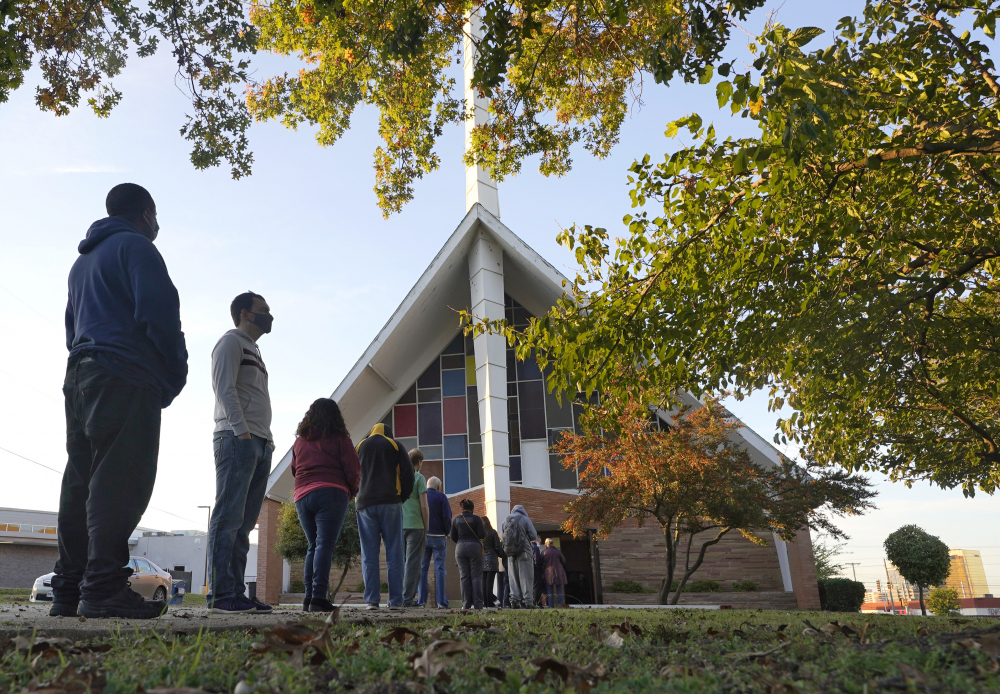
Voters line up outside Vickery Baptist Church waiting to cast their ballots on Election Day Tuesday, Nov. 3, in Dallas. AP Photo/LM Otero
The Associated Press tally reveals that the early vote in several states, including hotly-contested Texas and Arizona, has already exceeded the total vote of four years ago.
Early voting — whether in-person or by mail-in or absentee ballot — has swelled during the COVID-19 pandemic as voters have sought the safety and convenience it offers. The greatest gains have been witnessed in Kentucky, where almost 13 times as many voters cast their ballots early as in 2016.
This tiny N.H. hamlet was divided in 2016. This year was a Biden sweep.
One of the first communities in the nation to reveal its election results voted unanimously for Democratic presidential candidate Joe Biden early Tuesday, marking only the second time a candidate has swept the tiny New Hampshire hamlet in its 60-year tradition of midnight voting.
All five voters in Dixville Notch, about 20 miles south of the Canadian border, gathered at the now-closed Balsams Resort to become some of the first people in the country to formally submit their decisions. The residents drop paper ballots into a wooden box, and the votes are counted by hand.
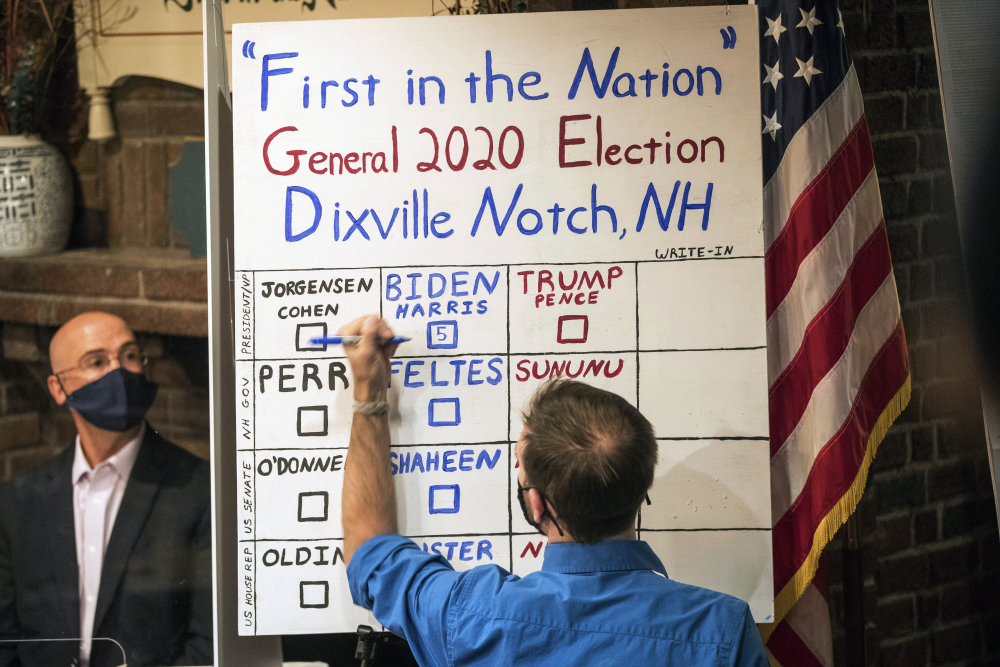
A man tallies the votes from the five ballots cast just after midnight, Tuesday, Nov. 3, in Dixville Notch, N.H. Democratic presidential candidate and former Vice President Joe Biden received all five votes. AP Photo/Scott Eisen
The only other time the community’s voters have been in agreement was when all nine chose Republican Richard Nixon over Democrat John F. Kennedy in 1960, the tradition’s first year.
On Monday, a video of one Dixville Notch resident explaining his vote for Biden attracted widespread attention. Les Otten described himself as a lifelong Republican who, despite disagreeing with Biden on many issues, felt that a vote for him was a vote for national unity.
“My vote today is meant to send a message to my fellow Republicans that our party can find its way back,” Otten said. “It’s time to return to the values the conservative party has held historically dear.”
Otten then became the first Dixville Notch voter to cast his ballot.
The 2020 results were a shift from 2016, when four Dixville Notch voters chose Democrat Hillary Clinton, two voted for now-President Donald Trump, a Republican, and one selected Libertarian Gary Johnson. An eighth person wrote in the name of now-Sen. Mitt Romney (Utah), the 2012 Republican presidential nominee.
Watching the results in Dixville Notch is a hobby for some political observers, although there’s no correlation between the outcome there and the final tally of the presidential race. While the hamlet was once a destination for presidential candidates, the visits have slowed to a trickle since the Balsams closed in 2011 and the local population declined with it.
Federal judge orders sweep of postal facilities for leftover ballots
A federal judge has ordered U.S. Postal Service inspectors to sweep postal facilities on Tuesday in several locations — including in six battleground states — to ensure that any mail-in ballots left behind are immediately sent out for delivery.
The last-minute order on Tuesday by Judge Emmet G. Sullivan in Washington, D.C., directs the law enforcement arm of the Postal Service to inspect facilities in central Pennsylvania, Philadelphia, Detroit, Atlanta, Houston, south Florida, Arizona and a few other locations between 12:30 p.m. and 3 p.m. Eastern time.
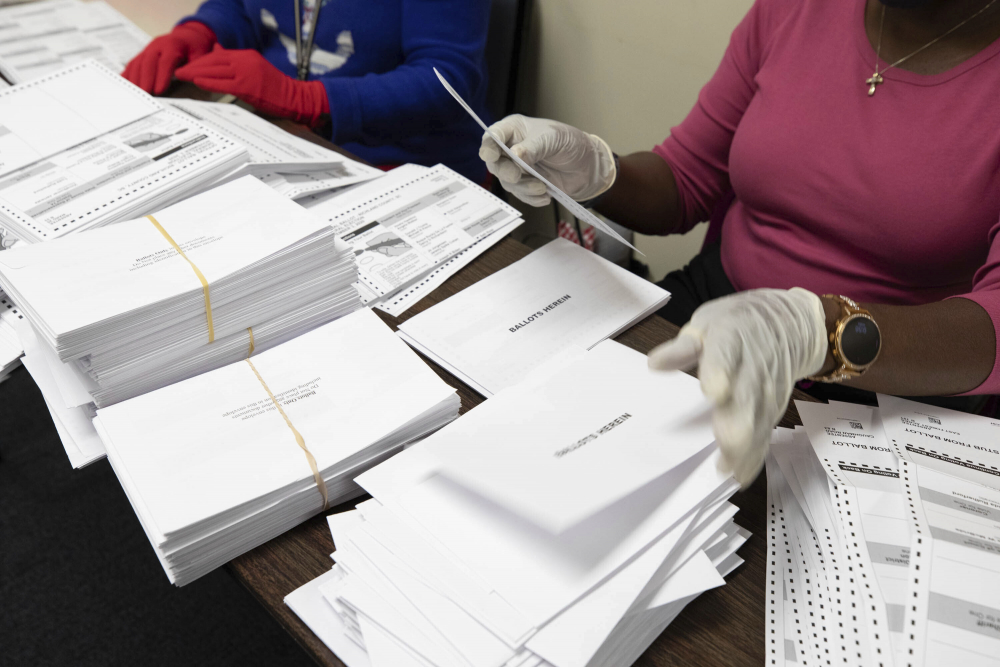
Workers prepare paper absentee ballots to be counted at the Richland County Administration Building in South Carolina on Tuesday, Nov. 3. Tracy Glantz/The State via AP
The order is part of one of several lawsuits against the Postal Service over cost-cutting measures that slowed mail delivery this year and raised concerns that mail-in ballots would not be delivered on time.
Recent data has shown that on-time mail delivery in some parts of the country has dropped to levels lower than in July, when millions of Americans went days, even weeks, without mail.
The order focuses on postal districts that have struggled to deliver ballots on time in recent days. It also centers on states that will not count ballots received after election day.
“No one should be disenfranchised for something that is out of their control. It’s important that the Postal Service do everything in its power to make sure that that doesn’t happen,” said Shankar Duraiswamy, an attorney for Vote Forward, a voting rights organization that filed the lawsuit prompting Sullivan’s order.
A Postal Service spokesman did not immediately respond to a request for comment.
Pro-Trump messages painted on headstones at Jewish cemetery
GRAND RAPIDS, Mich. — Police are investigating vandalism that left several headstones at a Jewish cemetery in Grand Rapids spray-painted with “TRUMP” and “MAGA” before President Donald Trump held his final campaign rally in the western Michigan city.
Grand Rapids police officers on Monday found six headstones spray-painted with red paint at the Ahavas Israel Cemetery.
The vandalism appeared to be “relatively new,” with “TRUMP” spray-painted on the back of four headstones, and “MAGA” — an acronym for the Trump campaign slogan Make America Great Again — spray-painted on two others, Sgt. John Wittkowski, a spokesman for the city’s police department, said in a statement.
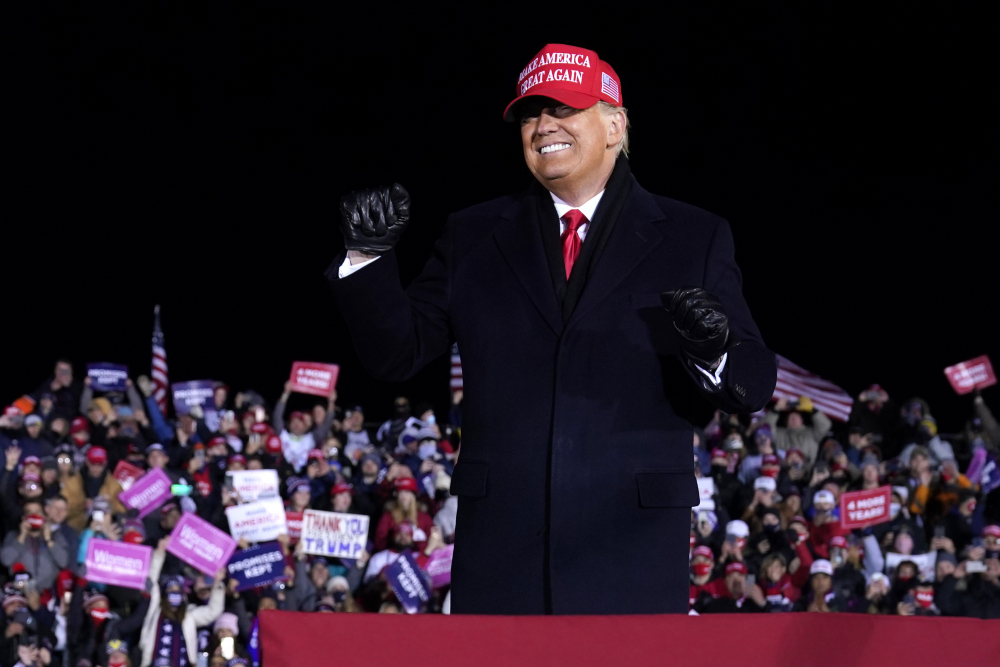
President Donald Trump dances after a campaign rally at Gerald R. Ford International Airport, early Tuesday, Nov. 3, in Grand Rapids, Mich. AP Photo/Evan Vucci
The vandalized graves were discovered hours before Trump visited Grand Rapids late Monday night in his final campaign rally before Election Day. Police said no evidence was left at the scene.
Wittkowski said the Grand Rapids Police Department had made no arrests or identified any suspects in the vandalism as of Tuesday morning.
The Michigan Democratic Jewish Caucus said in a statement Monday that it was outraged by “the desecration,” and said the vandalism just before Election Day was intended “to send an intimidating message to the president’s opponents, and particularly, Jewish voters.”
“But it has failed. Grand Rapids’ Jewish community will not be cowed by this vile attack on Ahavas Israel,” the caucus said in its statement.
The Anti-Defamation League of Michigan said it was working with local law enforcement to investigate the vandalized graves and that it was “appalled by the reported desecration.”
The Michigan chapter of the Council on American-Islamic Relations called Tuesday for federal authorities to investigate the vandalism as a hate crime and said it was offering a $1,000 reward for information leading to an arrest and conviction in the case.
“The sacred sites of people of faith must be protected from vandalism that is meant to spread fear and intimidation,” the Michigan chapter’s executive director, Dawud Walid, said in a statement.
Pelosi says she’s ‘certain’ Democrats will grow House majority
House Speaker Nancy Pelosi says she’s “absolutely certain” that Democrats will “solidly hold” onto their House majority.
On an Election Day conference call with reporters, the California Democrat said “this election is about nothing less than taking back the soul of America, whether our nation will follow the voices of fear or whether we will choose hope.”
Pelosi and Rep. Cheri Bustos say the party is reaching deep into Trump country to win seats. Bustos is chair of the campaign arm for House Democrats, who are well positioned to try to add longtime Republican seats in Long Island, Arkansas, Indiana and rural Virginia.
Bustos says Democrats “are going to see some wins in those deep red districts.”
Pelosi says she’s confident Democratic presidential nominee Joe Biden will win the White House from President Donald Trump.
Biden has spent the day visiting Pennsylvania. Trump had a phone interview on Fox News Channel.
Melania Trump casts her vote in Palm Beach
First lady Melania Trump has cast her vote, stopping in at a voting center in Palm Beach, Florida, close to President Donald Trump’s Mar-a-Lago resort.
Trump switched his residence from New York to Palm Beach County last year and voted in person on Oct. 24 during early voting. Asked why she didn’t vote with the president, the first lady told reporters on Tuesday: “It’s Election Day so I wanted to come here to vote today for the election.”
The first lady waved and smiled to reporters. She was the only person not wearing a mask to guard against the coronavirus when she entered the Morton and Barbara Mandel Recreation Center to vote, presumably for her husband.
Mrs. Trump’s spokesperson, Stephanie Grisham, says the first lady, who recovered from COVID-19, was the only person in the polling site, with the exception of a couple of poll workers and her own staffers, all of whom were tested.
Grisham says no one was near the first lady “because of social distancing and the privacy” people receive when they vote.
Mrs. Trump announced in a blog post last month that she had recovered from a bout with COVID-19 that included headaches, body aches and fatigue and said she had tested negative.
Election Day voting opens with some lines, scattered glitches, a lot of anxiety
Americans lined up for a long election season’s final day of voting Tuesday, breezing through cavernous facilities in some cities and waiting by the hundreds in others, and contending with only few scattered glitches in the first hours of Election Day.
Nearly 100 million people had already cast ballots as voting got underway, a stunning figure that underscored how the coronavirus pandemic has transformed this year’s election, as a record number of Americans voted early or by mail to avoid the risk of infection.
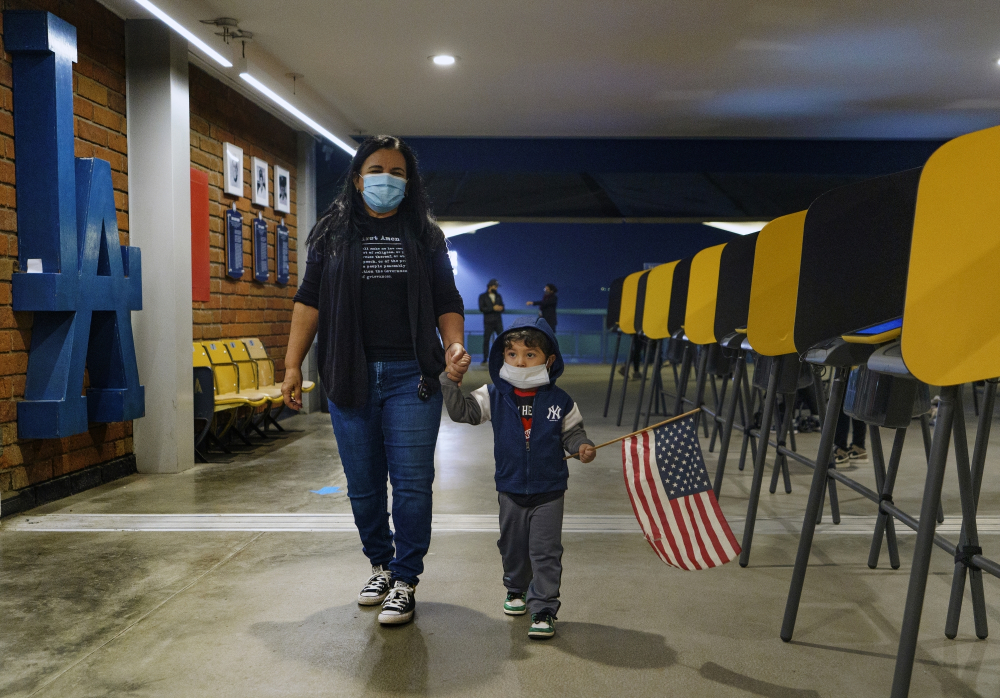
Lisa Carrera, a former Los Angeles Unified School history teacher from La Puente, Calif., holds the hand of her grandson Maverick, 2, after casting her ballot in-person at the Top of the Park at Dodger Stadium in Los Angeles, Monday, Nov. 2. AP Photo/Damian Dovarganes
Early turnout was light in Miami, Dayton, Atlanta and Louisville, prompting a tentative sigh of relief for election officials who have spent months preparing for complications arising from the pandemic. But long lines formed in other places, including New York City, Las Vegas, Green Bay, Wis., and St. Petersburg, Fla. – a reminder of the historic surge of interest in this year’s race for the White House between President Trump and former vice president Joe Biden.
“We don’t normally see lines this long, this early,” said Jonathan Kipp, an election administrator in Londonderry, N.H., where 563 people voted over the first hour. “Isn’t it great, though? People are looking to vote.”
Voters encountered a handful of obstacles Tuesday, including a snow quall in Manchester, N.H., and a few problems with machines and voter check-in systems in cities such as Columbus, Oh. and Philadelphia.
In many cities, the physical and economic toll of the coronavirus itself was on vivid display. In Kenosha, Wis., Angela Van Dyke waited along with about 100 other others in chilly temperatures as the sun rose Tuesday morning, despite her worries about exposure to the virus.
“It’s a civic duty to show up, even in the midst of a massive surge” of infections, said Van Dyke, who moved back to her home state from California after losing her job in architecture because of the pandemic. She accused Republican leaders in Wisconsin of being “lazy” in their management of the crisis, and she was apprehensive about safety protocols in her polling station as she stood in line.
Read the full story here.
Feds monitoring vote, say no major problems seen
Federal authorities are monitoring voting and any threats to the election across the country at an operations center just outside Washington, D.C., run by the cyber-security component of the Department of Homeland Security. Officials there said there were no major problems detected early Tuesday but urged the public to be wary and patient.
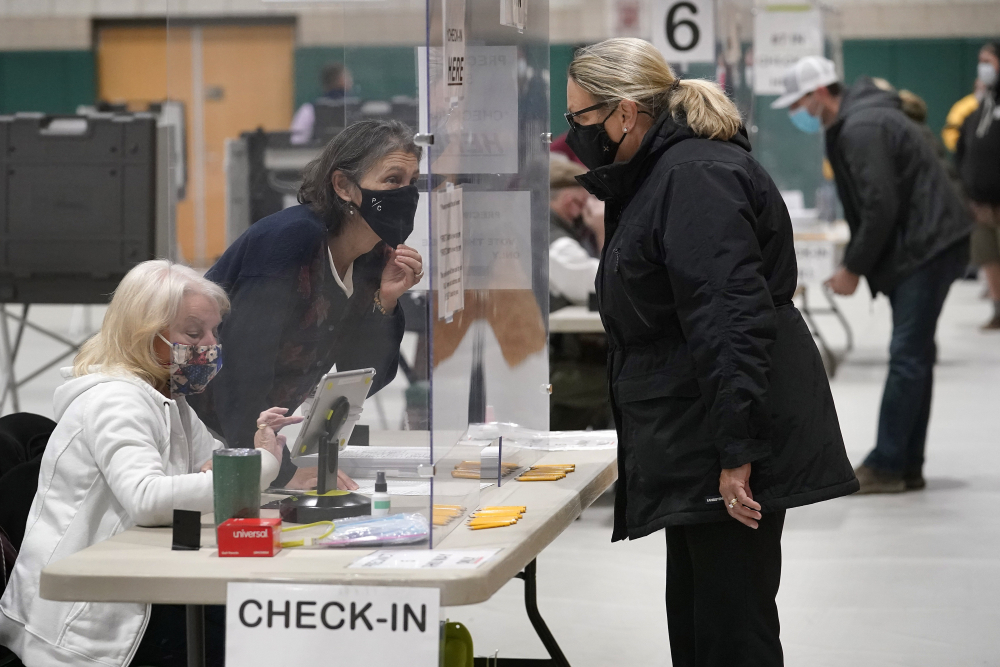
Poll Worker Suzan Winfrey, center left, speaks through a plastic barrier while assisting a voter in a polling station at Marshfield High School, Tuesday, Nov. 3, in Marshfield, Mass. AP Photo/Steven Senne
U.S. Cybersecurity and Infrastructure Security Agency director Christopher Krebs said from the center there was “some early indication of system disruption,” but he did not elaborate. He says he has “confidence that the vote is secure, the count is secure and the results will be secure.”
Krebs says officials have seen attempts by foreign actors “to interfere in the 2020 election.” But he says officials “have addressed those threats quickly” and “comprehensively.”
Krebs says Election Day “in some sense is half-time.” He says, “There may be other events or activities or efforts to interfere and undermine confidence in the election.” He asks all Americans “to treat all sensational and unverified claims with skepticism and remember technology sometimes fails.”
Potential for uncounted military votes looms large in swing states
WASHINGTON — Many states have thousands of mailed military ballots. Many states have tight deadlines for counting them. And many states are swing states. But this year six states stand out for checking all three of those boxes.
In Pennsylvania, Georgia, Arizona, Michigan, Wisconsin and Minnesota, state law provides little or no time after Election Day for military ballots to be counted. If the election is close enough, the outcome in one or more of those states could tilt the national contest one way or the other, and counting those ballots — or not — could determine the outcome.
Several factors could make it harder to count all ballots on time, whether mailed or cast in person. These include postal system delays as well as the sheer number of ballots of all types that are being cast — perhaps the most in U.S. history.
“These military ballots could indeed be pivotal,” said Susan Dzieduszycka-Suinat, president and CEO of Overseas Vote, an advocacy initiative of the nonprofit U.S. Vote Foundation. “Even one military ballot not counted is a loss to our nation. I see it as shameful and a lost opportunity for legislators and courts to be tightening up the ballot-receiving deadlines for military voters.”
A Military Times-Syracuse University poll this summer found that former Vice President Joe Biden had a four-point lead over President Donald Trump among surveyed military troops, typically considered a demographic that skews Republican.

FILE – In this Thursday, Sept. 3, 2020, file photo, stacks of ballot envelopes waiting to be mailed are seen at the Wake County Board of Elections in Raleigh, N.C. Time was dwindling for thousands of North Carolina voters to fix absentee voting errors as elections officials hustled out an updated process for handling mail-in ballot problems two weeks before Election Day. (AP Photo/Gerry Broome, File)
Contrary to what Trump has said, in every election, many states are still counting mailed-in ballots after Election Day. Even with the final count unfinished, media organizations in most cases can predict the outcome on the night of the election because the number of mailed-in ballots usually is not enough to decide the contest.
But excruciatingly tight races are not unheard of. In Florida in 2000, George W. Bush defeated Al Gore by just 537 votes.
In 2020, if the presidential contest turns out to be close, Pennsylvania could be the fulcrum on which it turns.
The Supreme Court ruled on Oct. 28 that the Keystone State can count votes received up to three days after the Nov. 3 election. The state’s election officials say they are setting those ballots aside to be counted later, if necessary.
Trump, anticipating the possibility that he will be ahead in Pennsylvania on election night, said over the weekend that he plans to sue to prevent the counting of those additional Pennsylvania ballots after Nov. 3.
Once the polls close Tuesday, Trump said, “we’re going in with our lawyers.”
Read the full story here.
Nation by nation, the world watches Election Day in the U.S.
For four years, the world’s nations have watched as a very different American president engages with the international community — or doesn’t.
Longtime alliances have been strained, agreements wiped away, tariffs erected, funding withdrawn. Some nations have been the objects of presidential derision. Others, like North Korea, have been on the receiving end of diplomatic overtures once considered unthinkable.
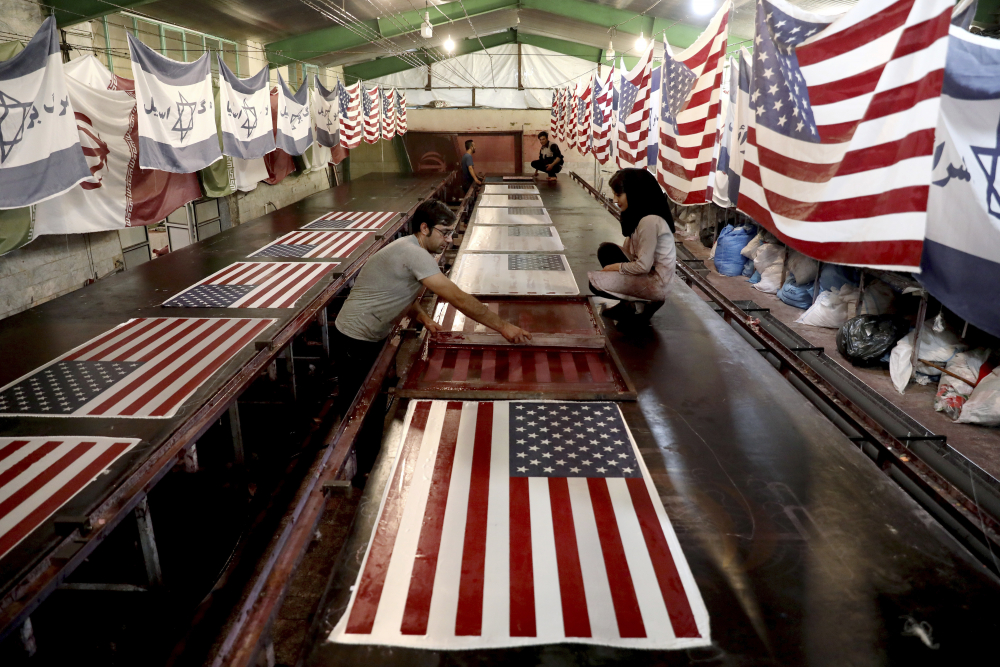
In this Saturday, Feb. 8, 2020 file photo, workers print U.S. flags using a silkscreen, at the Diba Parcham Khomein factory in Heshmatieh village, a suburb of Khomein city, in central Iran. AP Photo/Ebrahim Noroozi, File
For countries around the planet, the presidency of Donald Trump in its first term has been, it is safe to say, a singular experience to watch. Now that an inflection point in Trump’s time in office is at hand with Tuesday’s U.S. election, what’s at stake if his presidency ends — or if it continues? Nation by nation, how is Election Day in the United States being watched, considered, assessed?
Read the full story here.
Biden begins day with visits to church, cemetery
Joe Biden has started Election Day with a visit to church — and the grave of his late son, Beau.
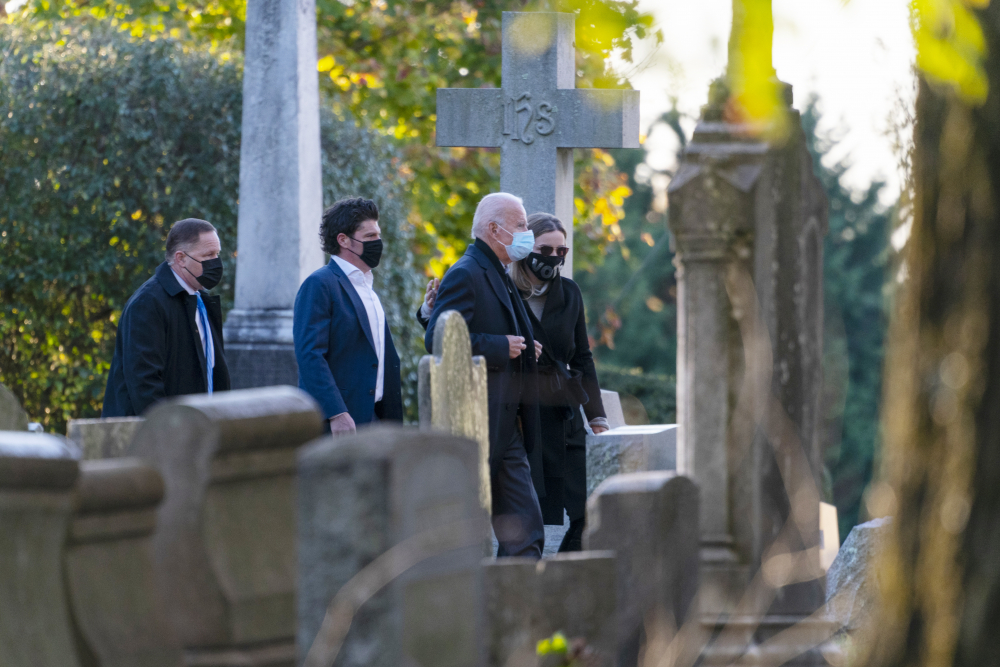
Democratic presidential candidate former Vice President Joe Biden walks with his granddaughter Finnegan Biden into St. Joseph On the Brandywine Catholic Church in Wilmington, Del., Tuesday, Nov. 3. AP Photo/Carolyn Kaster
Biden and his wife, Jill, made an early morning stop at St. Joseph’s on the Brandywine in Wilmington, Delaware, the church he typically visits on Sunday when home. Biden had granddaughters Finnegan and Natalie in tow Tuesday.
After a brief church visit, the four walked to Beau Biden’s grave in the church cemetery.
Beau died of brain cancer in 2015, and Biden often speaks on the campaign trail of his courage while deployed to Iraq as a major in the Delaware Army National Guard.
Biden’s late wife, Neilia, and infant daughter, Naomi, died in a car crash in 1972, shortly after Biden was elected senator. They are also buried in the cemetery.
Biden is spending the rest of his day in Pennsylvania as he makes a final push to get out the vote.
Trump says big rally crowds are ‘ultimate poll’
President Donald Trump says he believes his large rally crowds during his fast-paced weeks of campaigning are the “ultimate poll” and translate into a lot of votes for his reelection.
Trump told Fox News Channel’s “Fox & Friends” on Tuesday he will spend Election Day making phone calls to people who have been loyal to him and will go to his campaign headquarters in suburban Virginia to thank the staff.
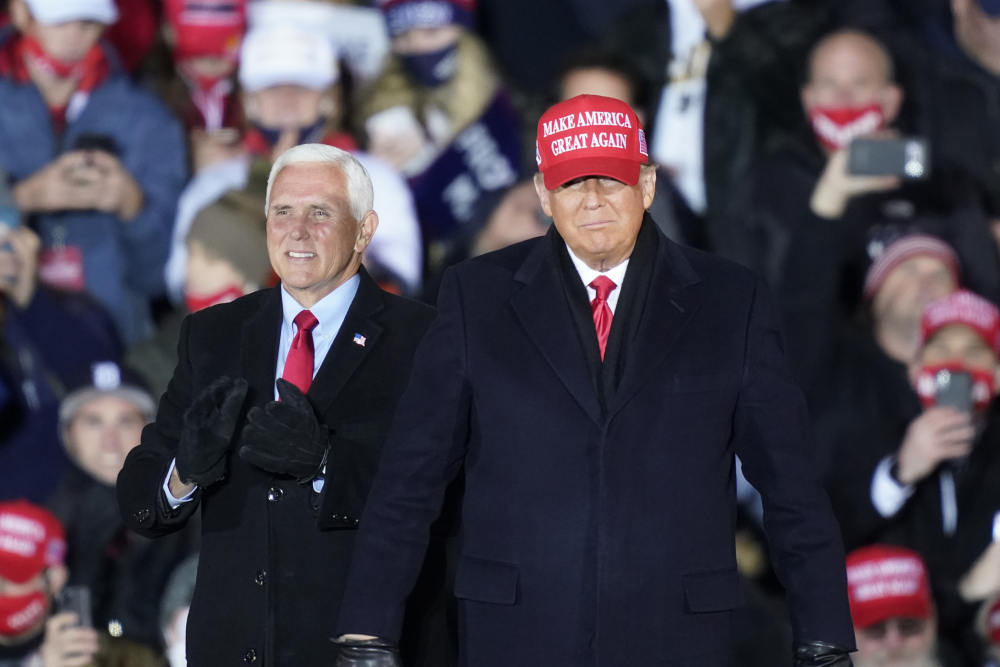
President Donald Trump arrives with Vice President Mike Pence for a campaign rally Monday, Nov. 2, in Grand Rapids, Mich. AP Photo/Carlos Osorio
Trump said he would declare himself the winner of the election “Only when there’s victory.” There has been concern that Trump will declare victory early — before vote counts are definitive. But the Republican president told Fox there’s no reason to “play games.” He says he thinks he has a “very solid chance at winning.”
Trump also says he understands why businesses are boarding up their storefronts but thinks it’s very sad they feel the need to do it. He predicts that if there is violence and unrest, it will be in Democratically run cities like Chicago; New York; Portland, Oregon; Oakland, California; and Baltimore and blames “weak leadership.”
Suspicious robocall campaign warning people to ‘stay home’ spooks voters nationwide
An unidentified robocaller has placed an estimated 10 million calls in the past several weeks warning people to “stay safe and stay home,” spooking some Americans who said they saw it as an attempt to scare them away from the polls on Election Day.
The barrage of calls all feature the same short, recorded message: A computerized female voice says the message is a “test call” before twice encouraging people to remain inside. The robocalls, which have come from a slew of fake or unknown numbers, began over the summer and intensified in October, and now appear to have affected nearly every Zip code in the United States.
The reach and timing of the calls recently caught the attention of YouMail, a tech company that offers a robocall-blocking app for smartphones, as well as some of the country’s top telecom carriers, which determined from an investigation that the calls may be foreign in origin and sophisticated in their tactics. Data from YouMail shows that the calls have reached 280 of the country’s 317 area codes since the campaign began in the summer.
While the robocall does not explicitly mention the 2020 presidential election or issues that might affect voters’ well-being, including the coronavirus pandemic, it still threatens to create confusion, said Alex Quilici, YouMail’s chief executive. And it illustrates worrisome vulnerabilities in the country’s phone system, he said, that sophisticated actors could exploit.
“If you wanted to cause havoc in America for the elections, one way to do it is clearly robocalling,” Quilici said. “This whole thing is exposing [that] it can be very difficult to react quickly to a large calling volume campaign.”
When Zach McMullen received a call Monday telling him it was “time to stay home,” he assumed the warning was related to the coronavirus. His co-workers at an Atlanta bakery had received the same message, and they initially figured it was the city government enforcing its public health guidelines.
But the “robotic voice” gave McMullen pause, as did the second call – and then the third, and the fourth – delivering the same monotone message on the same day.
“I think they mean stay home and don’t vote,” the 37-year-old concluded.
Read the full story here.
Send questions/comments to the editors.
