



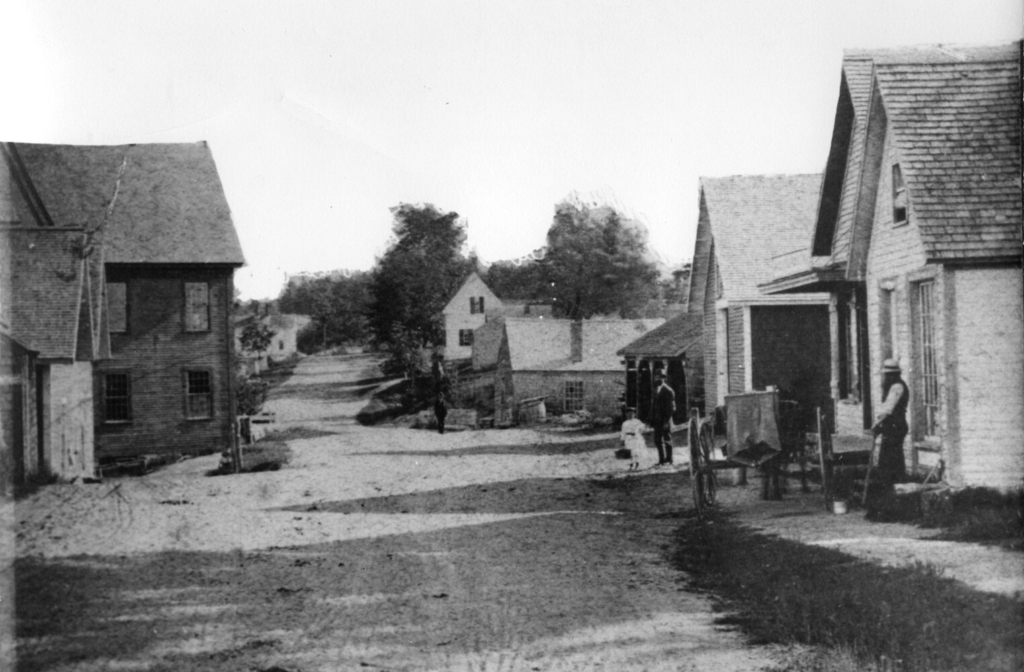
Norway’s Lower Main Street at Steep Falls, probably late 1800s. The building at right is the Grist Mill.
By the mid-1800s, the Steep Falls area at the south-eastern end of Main Street was a flourishing industrial development. Water power generated by the 65-foot drop along the outlet of the Pennessewassee Lake attracted a variety of mills producing paper, lumber, flour, piano keys, barrels, foundry castings, and shovel handles.
Let’s take a look at some of the investors and innovators who recognized the potential of this location. Asa Danforth, MD, affectionately known as Doctor Dan, moved to Norway in 1820. Respected as a generous and kind man, he made house-calls on horseback and carried a saddlebag full of medications. It was said locally that “no one died when he was at the house.”
In addition to medicine, his interest extended to innovative industry. Dr. Dan’s paper mill was at the uppermost location, or privilege, of the falls and utilized a new process. The factory began operation in January of 1848 and included the use of groundwood pulp in the manufacture of high-quality paper.
The David Noyes History of Norway lists the elements used and output of this new method: “100 tons of rags, 175 cords of wood, 150 casks of lime, 12 casks chloride of lime, 960 pounds oil of vitriol, and turns out $15,000 worth of paper annually.”
The mill employed six workers who rendered a product that quickly gained a good reputation. David Noyes’ book was originally printed on paper from this mill. The operation was sold and production continued until 1873, when the business became bankrupt. Probably the most interesting, or at least unique, mill at the Falls was right across the stream from the paper mill, the piano-key factory.
Using pine wood for the piano keys and basswood for organ keys plus $10,000 worth of ivory per year, A.J. Nevers of Norway produced 100 sets of keys each month. Between six and twelve employees produced these keyboards which were shipped to Boston, New York, and St. Johns.
The next mill down was that of Joel Parkhurst, who arrived from Connecticut in 1827. Parkhurst was described as “a peculiar man” because he wore the same clothing year-round, seeming to have no need for heavy clothing in the winter. His was a shingle mill producing 200,000 shingles annually. Two mills operated at the lower end of the falls.
One was a sawmill owned by A. C. Denison who moved to Norway in 1842 from northern Vermont. His mill cut about 600,000 board feet of lumber per year. When he first arrived, he “commenced trade in the store of J.B. Brown.” It must be noted that at this time there were no merchants; but, men involved in trade and Adna Denison fit this description perfectly.
He is known to trade for or purchase almost any commodity produced and offered. Obviously, he attracted a large clientele with this novel approach. After four years he moved the trade business to the center of the village and operated under the name of Denison & True.
The other mill at the lower end was the iron foundry of Brown & Co. All types of cast ironwork were produced here including stoves, farm implements, hinges, and latches, as well as sheet metal and tin products. Eventually, an electricity generating plant was added at the Falls.
This plant produced the power to operate the Norway & Paris Street Railway and provided lighting for the village. It continues to function and contribute electricity to the power grid.
Drop by the Norway Museum and Historical Society Saturdays from 9 to noon and view the exhibits and access the other resources available.
Comments are not available on this story.
Send questions/comments to the editors.
