



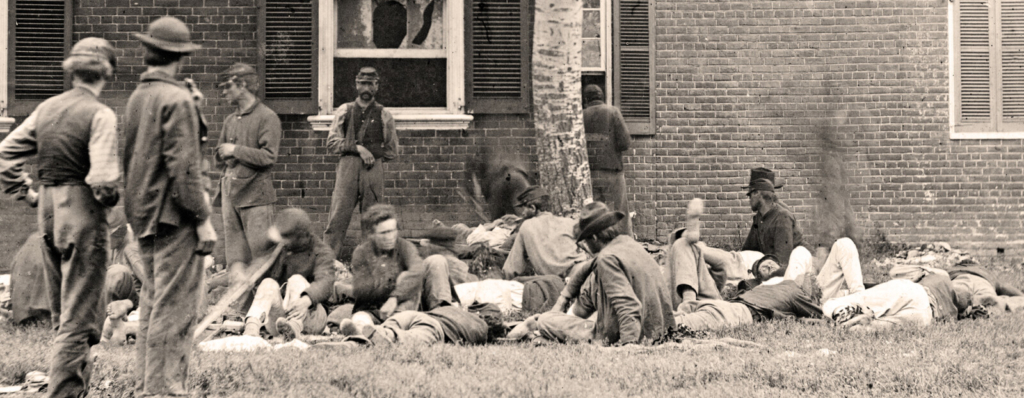
“Union Wounded from Battle of Wilderness outside Field Hospital, near Fredericksburg, Virginia, May 1864, zoomable image,” House Divided: The Civil War Research Engine at Dickinson Collegehttps://hd.housedivided.dickinson.edu/node/36448 Submitted
NORWAY — On a beautiful Sunday morning on August 1 of this year, a large group of friends and family gathered at the Fore Street Cemetery in Oxford to celebrate an unusual and amazing event. After more than 150 years, the resting place of an ancestor who served in the Civil War had been found and we were there to pay our respects. But there is so much more to this story…
Like my mother, I love delving into the history of my ancestors. Already being familiar with the two main branches, I chose to dig into my paternal grandmother’s (my dad’s mom) history. I began my search in 2000, checking local histories for info on Florence Christiana Cotton Record. From there I made several trips to Augusta to look through microfiche (ugh!), frequently taking Mom and Dad with me. I found documents, followed leads, and finally found the connection back to my great-great-grandfather Cotton who I knew had served in the Civil War. I found copies of his discharge from service and his death certificate – but after diligently searching, I found he wasn’t buried where his death certificate said he was, and there my trail went cold.
Fast forward several years. My cousin Doug Record and his wife Julie took the Ancestry.com DNA test and got the genealogy bug. Amazingly enough, Doug chose the Cotton line to follow as well, and we compared notes. But he ran with it! So much more information was now available, but still no gravesite. So we went back to the familiar. We checked the family gravesites at Riverside Annex and Fore Street cemeteries, and at Fore Street, next to Grammie Record, was an odd little marker. It was just a metal rod with a button-like knob at the top; no name or information. Recognizing the possibility, I checked the notebook at Paris Cape Historical for those buried in the Fore Street Cemetery but couldn’t find “Grampa Cotton” listed. Meanwhile, Doug and his dad, my Uncle Ed (who would be Grampa Cotton’s last remaining great-grandson at the age of 95) talked to the sexton, who confirmed that yes, indeed, Grampa Cotton was buried there. We were ecstatic at finding him at last, though appalled that he had laid there for over one hundred and fifty years without recognition. Doug petitioned the state for a memorial stone and I began plans for a memorial service.
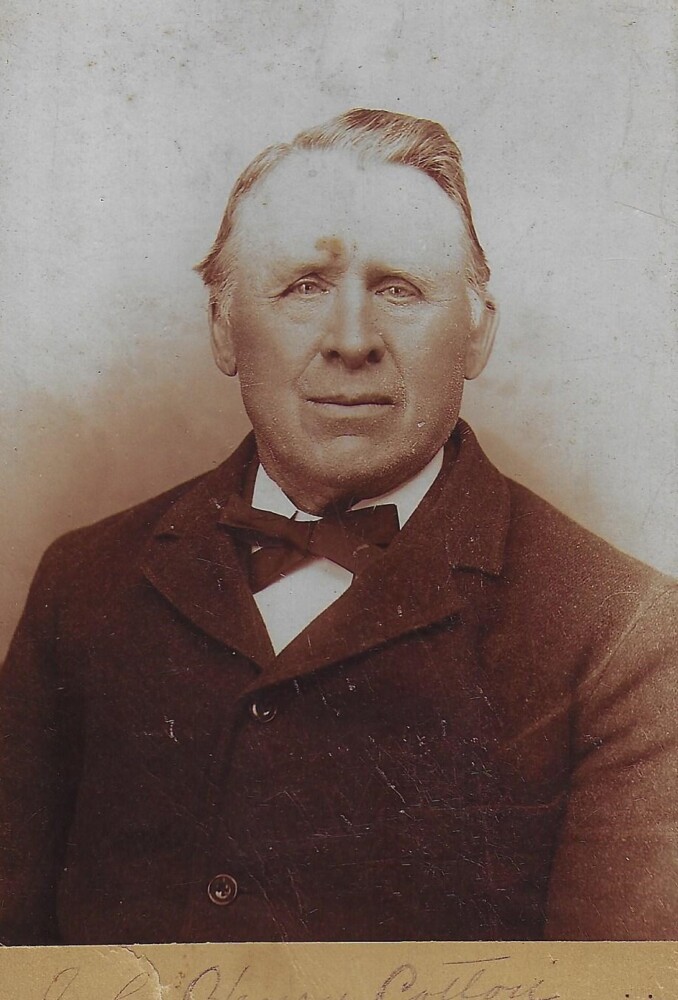
John Henry Cotton Submitted
Then tragedy struck. In November of 2018, Doug died unexpectedly and friends and family grieved his loss. I set aside plans for the memorial service until the following July when Uncle Ed asked that we go ahead, now as a way to honor Doug, too. But before we could pull it all together, COVID hit, and once again I set plans aside. Not sure if we should go ahead or not, I waited. Then in June of this year, our beloved Uncle Ed, the last of his generation, was diagnosed with a brain tumor and given only a couple of months to live. We knew how much he wanted the memorial service, and now it was a way to recognize all three of these much-loved men. And so…
On August 1, a large group of people gathered to celebrate the life of a Civil War Veteran and to recognize the work of his last remaining great-grandson and great-great-grandson. The service included Civil War-era music, a brief explanation of the search for Grampa Cotton’s resting place, the life of John Henry Cotton, DUV and SUV ceremonies, laying of a wreath, and placing of an American flag.
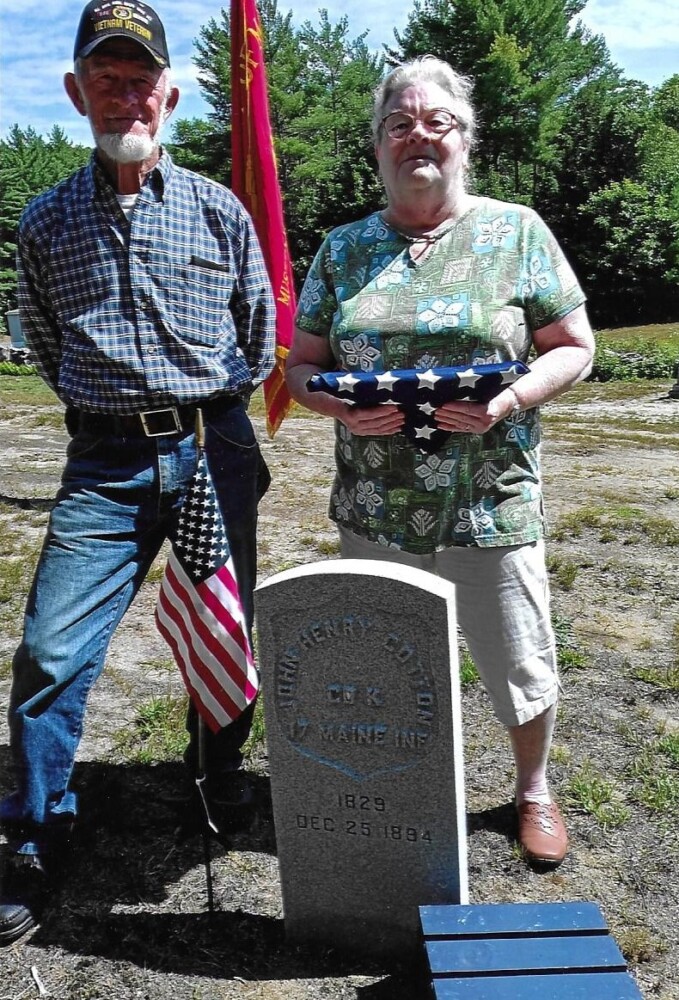
Lloyd Record, Vietnam Veteran and Lorraine Hill with donated flag from the Paris VFW and auxiliary stand with the new stone. Submitted
After the service, I visited with Uncle Ed, who had been unable to attend, and brought him an evergreen wreath and a flag from VFW Post 9787 Auxiliary, South Paris, many of whom were descendants of Grampa Cotton. We talked about the memorial service and he shared memories that I’ve been careful to preserve for future generations. Uncle Ed passed away on August 16, and again we grieve. But I will be forever grateful for the opportunity to have been a part of such an awe-inspiring event. Below is the text of the service given on August 1.
John Henry Cotton was born on April 25, 1830, the second of nine children born to William Cotton, Jr. who married Tryphena (Lunt) Cotton of Woodstock. His brothers and sisters were Richard, b. 1827, Meayard, b. 1831, (John Henry) Thomas, b. 1834, Abigail, b. 1835, Dinnett, b. 1837, Isabelle (Isabella), b. 1840, Sophia, b. 1843, and Lydia, b. 1845. About his young life, there is very little information, but as he grew and married, more pieces appeared and we were able to round out what Grampa Cotton might be like.
He married Christiana H. Cox of Woodstock and they made their home on a small mountain that came to be known as Cotton Mountain. (1) He stood 5’ 8” and had a light complexion with blue eyes and light hair. Together with Grammie Cotton they had seven children. (2)
The eldest was Laura Ann, born in 1852. She married a man by the name of Brock.
The next child was William Franklyn, born in Greenwood in 1857. William is the line of descent for, Lillian (Aunt Till), Florence (Grammie Record) and Guy.
After William came George Everett, born January 24, 1858, in Woodstock. George was later listed as shoe-maker.
The fourth child was Francis Llewellyn, born in 1861 in Auburn. He was married three times, the first ended in divorce, the second was to Lillie Esther Shaw, daughter of George Boardman Shaw, a carpenter who built the Shaw home later nicknamed “The Birches” on Paris Hill. After becoming a widower, Francis married a third time, to Nina Gibbs of North Paris.
After the war came Lendell Merritt, who was born on May 28, 1866. WikiTree records his death on June 3, 1957, in San Diego, California.
In 1867, Lydia was born, and last to come was Elizabeth, born in March of 1868. She later married Orlando S. Warren on January 1, 1895, in Lewiston.
He lived much of his life as a farmer on Cotton Mountain. He served as Superintendent of School District #10, which in 1857 was being taught at the Thomas Heath house.
At the age of 33, he enlisted in the 17th Maine Infantry on August 4, 1862. On his Civil War Service record, his residence was listed as Auburn. Left at home were Grammie Cotton and their four children, Laura, now 10, William 7, George 4, and Francis, 1.
Of the 17th Maine Regiment much has been written. (3) The 17th Maine Regiment sustained the heaviest battle losses of any Maine Infantry Regiment(4). For Pvt. John Henry Cotton, the days, months, and years became a series of battles against the Rebel soldiers. The names of these familiar battles have become part of our history: Fredericksburg, Chancellorsville, Gettysburg(5), Wapping Heights, Catlett’s Station, Kelly’s Ford, Mine Run, and The Battle of the Wilderness. On the second day of fighting at The Battle of the Wilderness, Grampa Cotton was wounded.
His right arm had to be amputated and he returned to a hospital in Augusta, where he stayed until January of 1865 when he returned home. One of Uncle Howard’s boys remembered hearing a story that Grammie Cotton didn’t recognize him when he returned home from the war. But the war was over for Grampa Cotton. He returned home to Grammie and his children and tried to take up his life again. It had to have been difficult, to say the least. But we know that Lendell, Lydia, and Elizabeth were born after his return from the war, so perhaps that was a comfort to them.
John Henry Cotton died on Christmas Day of 1894. His death certificate lists the cause of death as “cancer of the stomach” He was 64 years old. It also lists his place of burial as Mechanic Falls, which we now know isn’t true. After much searching, we found him here at Fore Street Cemetery, lying beside his grandson, Guy M. Cotton.
Rest in peace, Grampa Cotton, your family has come to pay its respect to a man who well deserved it.
Comments are not available on this story.
Send questions/comments to the editors.
