

Editor’s note: This story contains mentions of suicide and child murder.
A prolific letter writer. A knitter. A delightful, brilliant person. A good mother.
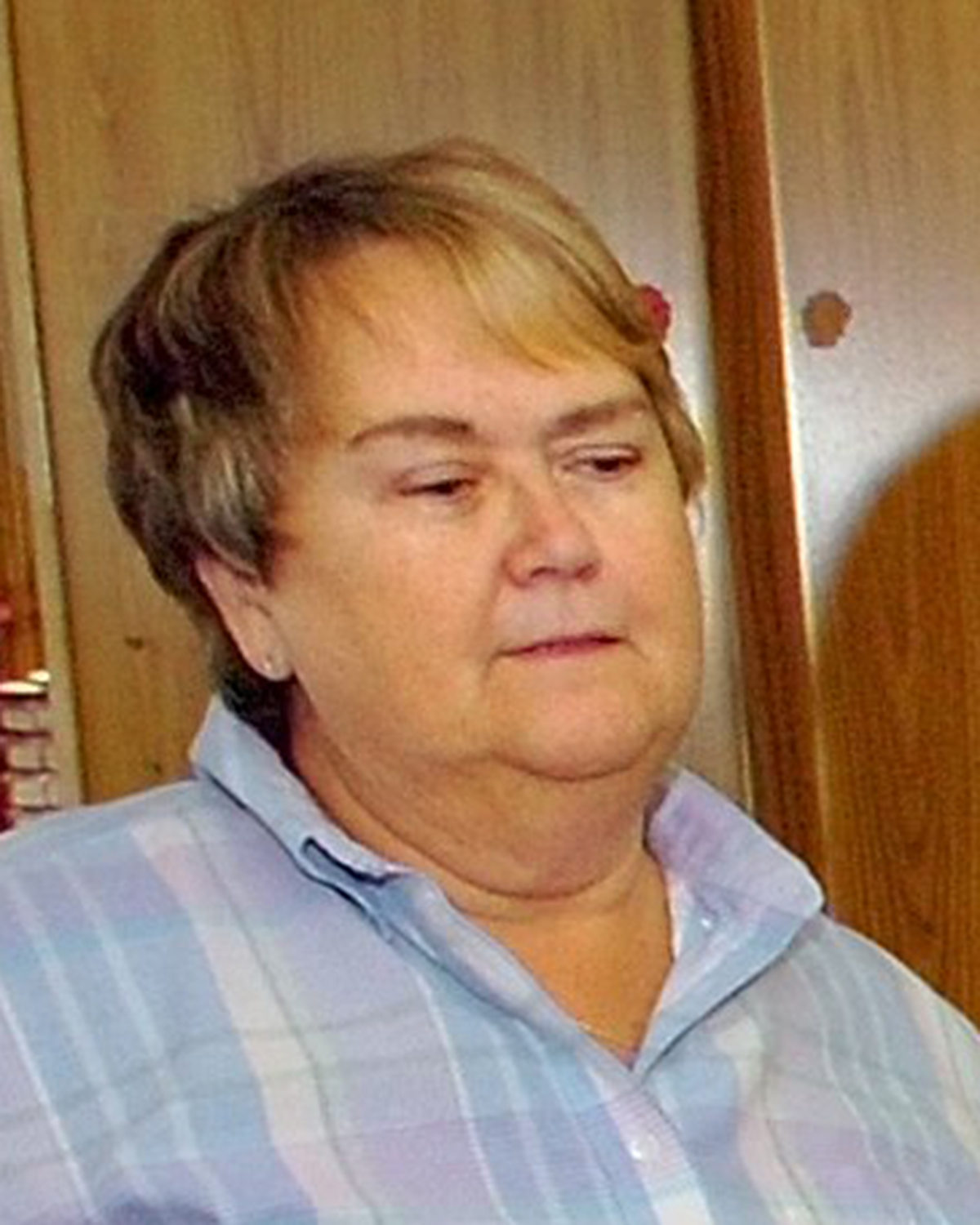
That’s how Louise Marcoux Bowker remembers her sister Constance Fisher six decades after Fisher became the center of national attention after killing her six children, and later drowning in the Kennebec River.
The tragic case that shook central Maine in the 1950s and 1960s still reverberates today.
After the trial of Lindsay Clancy, a Massachusetts woman who is accused of killing her three children in 2023, similarly captured national attention, Bowker questions why women are still not receiving the postpartum care they need.
Bowker blames a lot of people for the loss of her sister and her children, but she doesn’t blame Constance, or ‘Peggy’ as her family knew her.
“(Doctors) need to pay attention when somebody has the courage to ask for help,” Bowker said.
THE CASE OF CONSTANCE FISHER
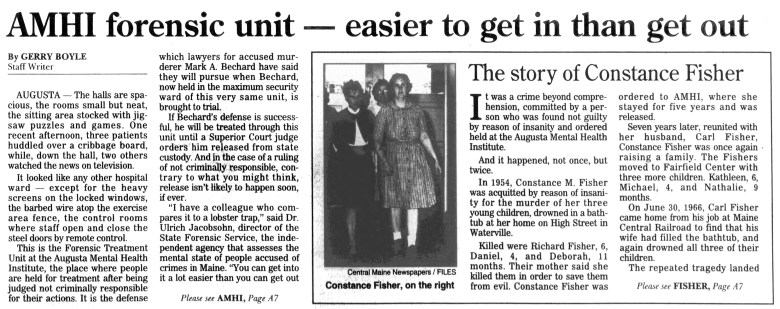
To outside observers, Constance and Carl Fisher were no different from any other couple building their lives after World War II.
He was a veteran working for Maine Central Railroad and she was a 17-year-old bride when they settled in Waterville.
Born in 1929 in Oakland, Constance Fisher was the foster child of Bowker’s grandparents, but that never made any difference — they were sisters to each other.
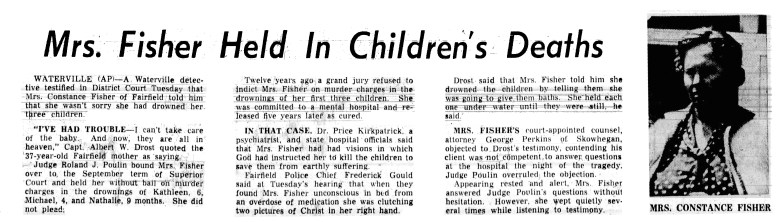
After the birth of her third child, Fisher began experiencing postpartum depression symptoms and sought out consultation from a psychiatrist, according to a 1954 Associated Press account.
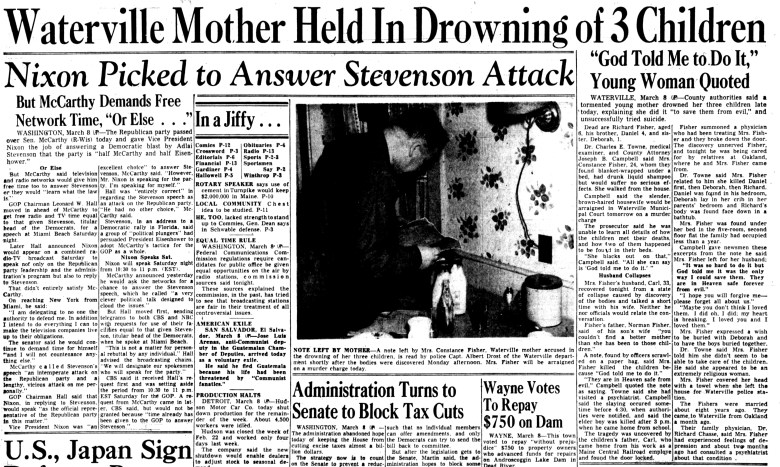
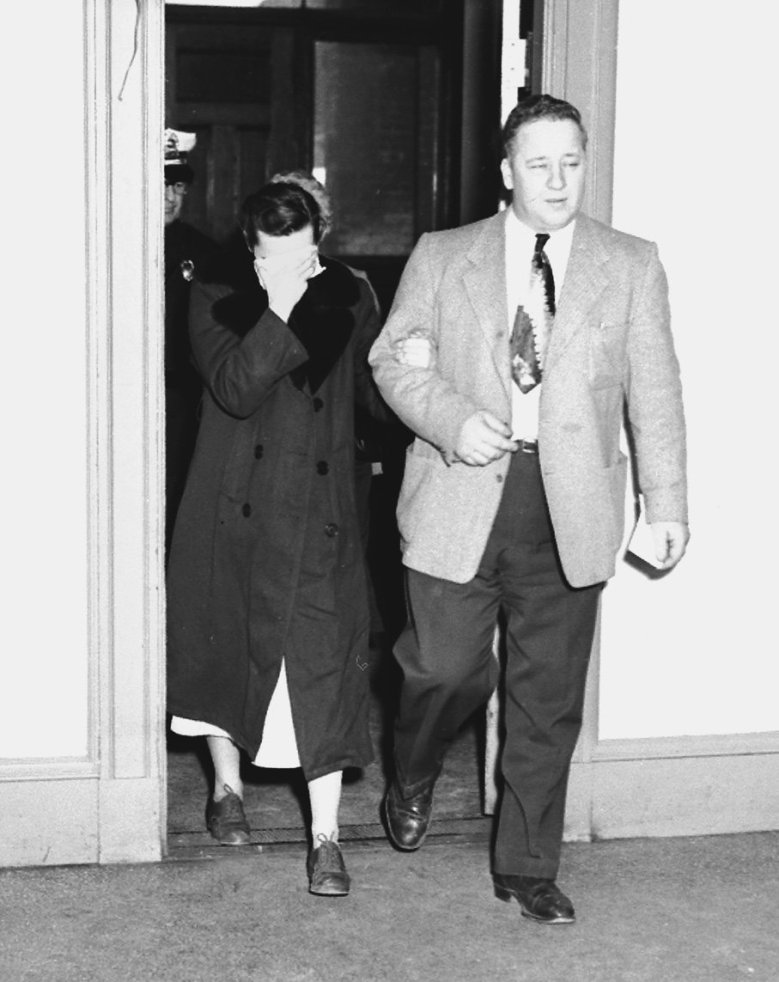
On March 8, 1954, Fisher killed her three children, aged 6, 4 and 1, in their home before attempting to take her own life.
“It was so hard to do it but God told me it was the only way I could save them. They are in Heaven safe forever from evil,” a note she wrote read. “I hope you will forgive me — please forget all about us.”
Fisher’s doctor said she had told him she didn’t feel able to take care of the children, according to the account.
“When this came down, it was like pulling a shade down, the whole world was black,” Bowker said of her sister’s postpartum depression. “And she truly felt that they would be better off, you know, in another world,”
Fisher was deemed not competent to stand trial. She was institutionalized at the Augusta Mental Health Institute for treatment. After showing improvement, Fisher was released five years later.
Bowker said Peggy and Carl asked doctors if he should get a vasectomy. Doctors encouraged them to move on with their lives and have more children, saying Fisher had recovered, Bowker said. The couple moved to Fairfield and had three more children.
After the birth of her youngest child, Fisher began experiencing the same symptoms as before, with Bowker citing a “plunge of hormones” after giving birth as a contributing factor. Bowker said her sister again sought help at the hospital, begging to stay there as she didn’t feel safe at home. She was sent home; doctors said she was fine.
A week later, on June 30, 1966, in a repeat of the earlier tragedy, Fisher killed her three children, aged 6, 4 and 9 months, before attempting again to take her own life.
Fisher was found not guilty by reason of insanity and was sent to the Augusta Mental Health Institute permanently. In 1973, she escaped. Her body was found over a week later, floating in the Kennebec River. She was 44.
“It just tore me apart,” Bowker said. “I just couldn’t believe that after everything that had happened, that when especially the second time she asked for help, she didn’t get it. And I blamed the state for the whole tragedy.”
‘A WASTED LIFE’
Six decades later, Bowker, now 81, still wonders why her sister wasn’t given the help she needed.
“It was tragic to think of a wasted life that she could have gone on and lived a happy life with her family had she gotten the help she needed,” Bowker said.
Bowker visited her sister shortly before she sought hospitalization before the second killings. They did laundry, Fisher made crab meat sandwiches for both of them and they talked like sisters do.
Fisher never indicated things were getting bad again, Bowker said. She was a private, religious person — she spoke to her priest, her husband and her doctor about what she was experiencing.
“I kept chastising myself for not paying attention,” Bowker said. “I just thought, had I gone to visit her the day before, would I have known? Would I have said, ‘Let me take the kids for a couple of days?’ But there were no indications.”
Who she really blames though, are the systems that failed to treat her sister each time. She blames the doctors who told her sister she was fine and encouraged her to have more children. She blames them for telling her to leave the hospital, even when she begged to stay. She blames the state for not providing better care.
Bowker said even though the hospital was the only option for treatment, it wasn’t a good place to be. Before her sister’s death, Bowker and the rest of Fisher’s family visited her in the hospital frequently.
“All you would have to do is visit somebody in one of those wards, and you would come out thinking, ‘If I had to stay here for 30 days in a row, I would leave here with something wrong with me,'” Bowker said. “It’s just horrific, like, the constant agitation and noise. It’s horrible, and she did that for years and years and years.”
But Fisher persevered, she said, even setting up an entire mail and package delivery system within the hospital.
“She was brilliant,” Bowker said.
Bowker said many people in the community who knew their family were empathetic, especially when they heard she had tried to get help and was turned away.
Throughout the whole experience, Fisher’s husband stood by her.
“Carl never gave up on her. He loved her until he died,” Bowker said.
‘THE CONSTANCE FISHER TRAGEDY’
Constance Fisher’s tragedy is still a living memory for some.
“I can remember in 1966 when my mom read it in the paper,” Bob Briggs said. “She was just in tears about it.”
When he came across a story about it years later in the library, the Hallowell resident and author was inspired to write “The Constance Fisher Tragedy,” published in 2011.

Briggs spent over a year researching and talking to family members, expert psychologists and even some of the doctors who treated Fisher to craft his comprehensive account.
In the introduction to the book, Bowker wrote her hope was it would educate both doctors and the general population about postpartum mental health and help them to recognize similar cases, preventing further tragedies.
Briggs said both times Fisher killed her children, she was hearing voice commands in her head.
Phillip Resnick, a forensic psychiatrist who has provided expert testimony in numerous high-profile murder cases including the recent Clancy trial, told Briggs that Fisher likely genuinely believed that she was doing her children a favor at the time.
“She was tormented by depression,” Briggs said. “I mean, unless you’ve experienced it, you have no idea what a terrible, horrible thing that was.”
Fisher was released from the hospital during a major national movement to deinstitutionalize those suffering from mental health illnesses. Briggs said he thinks that’s partly why Fisher was released at all.
Someone once asked Briggs, who said he often found himself in tears while writing the book, what he would do if he saw Fisher walking down the street.
“I would go over and give her a big hug,” Briggs said.
THE CLANCY TRIAL
Lindsay Clancy went on trial in July. After seven weeks, a mistrial was declared when the jury failed to reach a unanimous verdict.
Her lawyers argued she suffered from postpartum psychosis and bipolar disorder, making her not criminally responsible for the crimes. Prosecutors said she planned the crime, sending her husband to pick up food so he was out of the house, according the New York Times.
Eleven jurors agreed that Clancy was not guilty; a sole juror did not.
The case captured international attention. During the trial, hundreds gathered outside the courthouse to stand in support for Clancy and advocate for the need for greater mental health treatment, especially for mothers.
Bowker thinks doctors failed both Clancy and her sister.
“Both women asked for help,” Bowker said. “(Clancy) asked for help. She didn’t get it.”
Various news accounts reported Clancy, a labor and delivery nurse, sought help for her postpartum anxiety and depression before the killings. Her symptoms included suicidal thoughts and inability to sleep, and she admitted herself into outpatient care for postpartum depression and then later voluntarily entered inpatient treatment at a hospital for several days before being released. She consulted with psychiatrists and was prescribed over a dozen different medications, according to the New York Times.
Both Clancy and Fisher reportedly heard voice commands telling them to kill their children, an example of auditory hallucinations.
“I see a lot of parallels there,” Briggs said. “But I think the biggest thing is the mental health community has dropped the ball. And, you know, they think if you just write a prescription and a check, you’re good to go. And it just isn’t so.”
The next hearing date for Clancy’s case is set for Sept. 29, but it is still unclear whether she will face a retrial.
Bowker said hearing about the Clancy trial has been difficult for her, because she feels there is a lack of understanding about what Clancy — and her sister — were going through.
“I’m furious, and I hate hearing the newscasters say over and over again … ‘She meant to kill them,'” Bowker said. “And I just so want to call in and say, ‘You don’t know what you’re talking about. You need to stop talking.’ But it would do no good.”
Bowker wants women to know they can ask for help. She wants doctors to ask more questions. And most of all, she wants them to listen.
IF YOU NEED HELP
IF YOU or someone you know is in immediate danger, dial 911.
FOR ASSISTANCE during a mental health crisis, call or text 888-568-1112. To call the Suicide and Crisis Lifeline, call 988 or chat online at 988lifeline.org.
FOR MORE SUPPORT, call the NAMI Maine Help Line at 800-464-5767 or email helpline@namimaine.org.
OTHER Maine resources for mental health, substance use disorder and other issues can be found by calling 211.



Comments are not available on this story. Read more about why we allow commenting on some stories and not on others.
We believe it's important to offer commenting on certain stories as a benefit to our readers. At its best, our comments sections can be a productive platform for readers to engage with our journalism, offer thoughts on coverage and issues, and drive conversation in a respectful, solutions-based way. It's a form of open discourse that can be useful to our community, public officials, journalists and others.
We do not enable comments on everything — exceptions include most crime stories, and coverage involving personal tragedy or sensitive issues that invite personal attacks instead of thoughtful discussion.
You can read more here about our commenting policy and terms of use. More information is also found on our FAQs.
Show less