
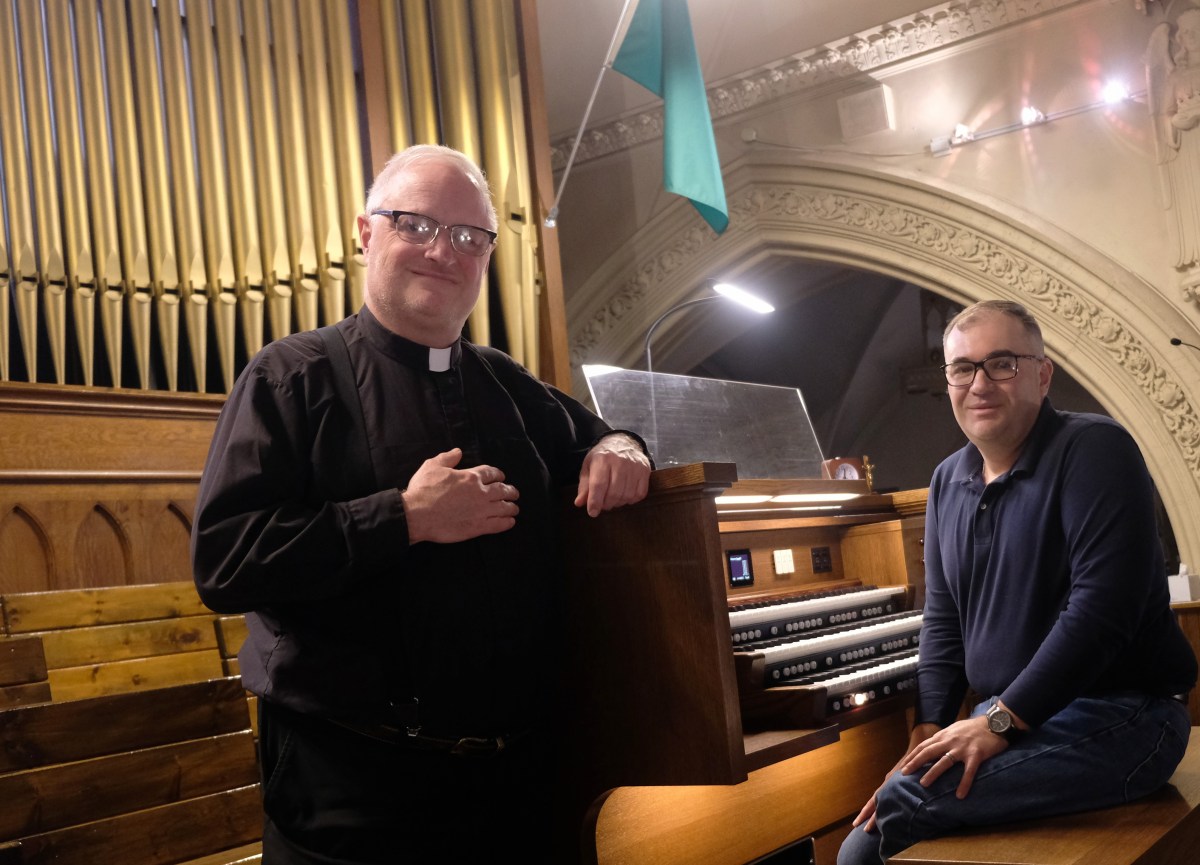
RUMFORD — Until about a half century ago, most large churches featured a pipe organ — a large musical instrument that produces sound by pushing air through rows of metal or wooden pipes.
Now, many of those churches, like St. Athanasius & St. John Church in Rumford, are modernizing, opting to digitize their instruments as parts for the aging pipe organs become increasingly hard to find and difficult to repair.
On Palm Sunday in late March this year, the church received a new Rodgers digital organ, and so far it’s living up to expectations.
“This new digital Rodgers console does everything the pipes do, and so much more,” St. Athanasius organist Nick Puiia said. “Most people could not tell the difference if I played the pipes or I played this. Not knowing what it was, I probably could not tell the difference.”
The old Estey pipe organ at the 126 Maine Ave. church was installed in 1927. Puiia said it’s been rebuilt a few times over the past years, but two years ago, it had a catastrophic failure.
“The control system behind it, all the electronics, just went fried,” he said. “The pipe organ was in need of a new rebuild anyway, and it was controlled by a 40-year-old Rodgers console, which also had some electronic voices that filled out the pipe sounds.”
Puiia said they looked at many different options to repair the old half pipe, half electronic organ, but the cost would have been “astronomical.”
“In addition to having to replace the console because the 1987 Rodgers console, in order to run the pipes, we had to have a special chip made,” he said. “And it was written in binary code by a gentleman from MIT, and it was just for that instrument, and we were on the spare.”
Puiia said he first played the old organ in 1991, and he’s been playing regularly here since 1994.
He said St. Athanasius’ pipe organ was built for the church to be filled with 1,100 people.
“It was very, very loud. We have 125, 150 people at mass,” Puiia said. “It was always too loud. On the pipe, you can’t control how loud it is. With the new organ, we have not heard a complaint that it’s too loud.”
The previous two or three years with the analog organ, Puiia said, “It was fighting me. Things weren’t working. I had to figure out what worked. What worked one day didn’t work the next. Now having everything work like it should is a treat.”
As churches modernize, he said, the old pipe organs are hardly ever used, “even if they still exist.”
“They’ve gone silent over the years,” Puiia said.
TOO EXPENSIVE
Puiia said one of the biggest factors in switching to the digital organ was cost.
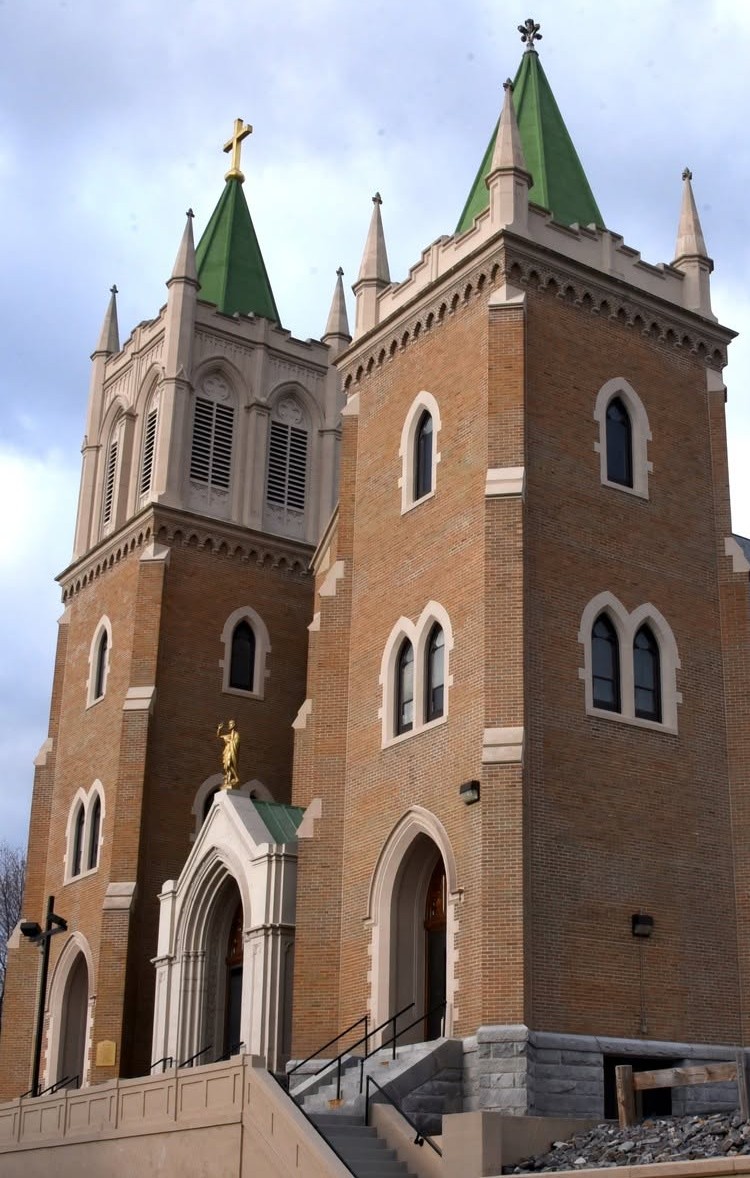
“We had the money for the digital organ,” he said, which cost $98,000. “We didn’t have the money to repair the pipe organ,” Puiia said. “What we replaced was the console that controlled the pipe organ.”
Puiia said the pipes are in really good shape, but everything underneath it is all cracked, and the wind lines needed to be redone, a process that hasn’t happened since the 1970s or ’80s.
Additionally, finding someone who knows how to repair this type of organ is also difficult.
“The way this organ was built, it was not built to be fixed,” he said. “…They were built for your average country church that didn’t have a lot of money. They were just a working-class organ. They weren’t built as concert instruments, or with the future in mind.”
Repairing the pipe organ is “on the way, way back burner because it’s a half-million dollar-plus project. Some of the quotes were over a million dollars to get the pipe organ up and running in this church,” he said.
With the new digital organ, Puiia said fixing the pipe organ is “the last thing we need to think about.”
The church, he said, needs new floors and also needs to be painted.
“There’s other priorities,” he said.
Puiia added, “Now that we have a 100 percent working instrument that does everything we need, the pipe organ is the last thing we need to think about.”
The Rev. Aaron Damboise, pastor of Parish of the Holy Savior, which includes St. Athanasius & St. John and Our Lady of the Snows in Bethel, said having the new digital organ is a two-part blessing.
“The organ is extremely important in the amount of worship because it’s one of the instruments that’s been used for centuries to help raise the heart and mind,” he said.
Damboise said having Puiia play helps elevate the music program.
“Being able to play the organ is becoming a skill that’s not being taken up by a lot of younger people,” Damboise said. “We’ve got some younger people in our congregation, so we’re hoping that by having them hear this that they’ll be interested in this instrument.”
Damboise said the money to replace the old organ was set aside for the church, but it needed to be done.
“In the end, we thought we’d have time to think about raising money, but we didn’t end up having that,” he said.
Damboise said the church has a congregation of about 400 people.
OLD VERSUS NEW
Puiia said the new organ includes four musical styles — American, British, French cathedral and North German baroque.
“It’s just different styles. This can pretty much play every type of organ music ever written, the way the composer wanted it to sound,” he said. “This instrument has some non-organ sounds in it, as well as a full piano. That technology wasn’t there 40 years ago. There’s so much in this.”
The new organ is very user friendly, Puiia said.
“It also has the same layout as our former one, so pretty much everything is where it was,” he said. “This was pretty much the replacement model for the other one.”
Puiia noted another difference with the new organ is that he can record music that could be played if he isn’t there. “Then someone downstairs could play it with their app on their phone,” he said.
The old organ was about double the size, and inside was row after row of components, capacitors and resistors. Inside the new organ was a small compartment about the size of an I-Pad, Puiia added.
The old organ received maintenance twice a year, but as time went on, it became more difficult to find someone to do the work because other churches weren’t maintaining their organs.
“There was a time when our tuner would come and he’d stop here and then go to the Green Church in Mexico to tune their organ. As time went on, as their funds dwindled, the Mexico church stopped using them, so what was $700 became $2,500 for that service twice a year,” said Puiia.
There’s really no maintenance to the new organ, he said, which they searched for for three and a half to four years.
Puiia said the analog organ went to the landfill.
“It was just old electronics. There was no longer parts available for it,” he said. “It was the equivalent of a 1970s TV.”
DEDICATION
St. Athanasius will hold a dedication of the new Rodgers digital organ on Sunday, Oct. 11.
The day will begin at 9:30 a.m. with a special mass with a blessing of the organ by Fr. Aaron Damboise. After mass, there will be an open house in the choir loft to look at the organ and experience it first hand.
At 2 p.m. a recital will be held featuring Scott Vaillancourt, music director at St. Peter and Paul Basilica in Lewiston, with music from all periods.
Puiia noted that years ago, Vaillancourt delivered a recital using the old organ, “so he’ll be recreating some of the programming he did on that one (with the new organ).”
On Dec. 27, the Sunday after Christmas, Puiia said the church will be having a Festival of Lessons and Carols, a non-denominational service that will include people from many churches throughout the area.
“We’ll be creating a giant choir, and they’ll be singing a variety of Christmas pieces and some readings,” he said. “That will be another part of the introductory year of the organ.”
He added that if it goes well, it may become an annual event in this church.
Another big event will soon be in the planning stages.
Damboise said the church will celebrate the 100th anniversary of the building on Christmas Day 2027.
In 1905, a group of Franco Americans came together and purchased the land to build a Catholic church. Construction began in 1906 and finished for Christmas midnight mass in 1927. It was built on the basement church of St. John Baptiste and served the French-speaking parishioners until 1970 when the parishes of St. Athanasius and St. John merged.
We invite you to add your comments. We encourage a thoughtful exchange of ideas and information on this website. By joining the conversation, you are agreeing to our commenting policy and terms of use. More information is found on our FAQs. You can update your screen name on the member's center.
Comments are managed by our staff during regular business hours Monday through Friday as well as limited hours on Saturday and Sunday. Comments held for moderation outside of those hours may take longer to approve.
Join the Conversation
Please sign into your Sun Journal account to participate in conversations below. If you do not have an account, you can subscribe here. Questions? Please see our FAQs.